
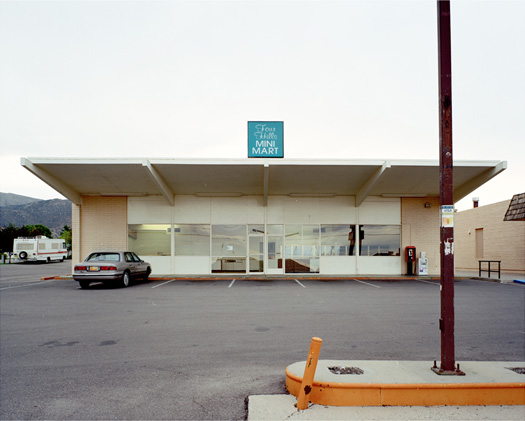
[“Mini-Mart, Albuquerque, NM”; photographer Paho Mann documents the diverse array of stores that re-inhabit the empty shells abandoned by the national corporation Circle-K; the current lives of Circle-K’s include “a dry cleaners, a couple of florist shops, a tattoo parlor, a tuxedo rental place, several mini-marts and dollar stores, and Bridgett’s Last Laugh Karaoke and Fish Fry.” More evidence of the suburb as a locus for informality in the American city. See the full slideshow at Places, and a map of the locations Mann is studying in Phoenix and Albuquerque on his website.]
-
recent posts
- mud and oil
- dredgefest california
- prosthetic landscapes in a time of acceleration
- Excavations, Shockwaves, and Limits
- on landscape science
- sea ice small multiples
- the dredge underground
- the five thousand pound life: land
- suburban futures
- pilot projects
- landmarks
- territorial reclamation
- landscape information modeling
- mesosphere excavations
- semipile
-
recent comments
- rholmes: Thanks for your comments, all. Brian: I look forward to your further thoughts on my first two points. Where...
- Michael: A little late to the party but here nonetheless. Needless to say I’m quite sympathetic to the pursuit...
- building nothing out of something: 30;] home // hide asides // links // index.archive // contact us // teaching //...
- Brian: well, there are few things more gratifying than producing something that people I admire and draw from engage...
- Brett: So it seems it would be great if the new Places interface could include a comment forum to give the authors...
- Ryan Lee Waldron, PE: I don’t think Landscape Architecture should be renamed landscape science, just as I...
- Alan Wiig: For whatever reason, when reading this commentary I thought of John McPhee’s book The Pine Barrens,...
- Julian Raxworthy: Interesting discussion Rob, and great to be referred to and introduced to your blog. Reading this...
- Thoughts on Everything under the Sun or I am a guilty Secularist: 30;] h/t m.ammoth.us […]
- Anchorite: If NM fails to meet its water obligations to TX they don’t pay a simple penalty, a federal judge...
-
monthly archives
-
category archives
-
tags
anthropocene architectural-criticism architecture army-corps-of-engineers atchafalaya china climate-change competitions dredge dredge-research-collaborative ecological-urbanism-at-gsd economics flood-control geology glacier-island-storm hacking-infrastructure hydrology infrastructural-vernacular infrastructure internet iphone kazys-varnelis landscape landscape-architecture landscape-futures landscape-infrastructures landscape-urbanism los angeles louisiana mississippi-river networked-urbanism new-urbanism new york city photography post-industrial re-industrial reading-the-infrastructural-city readings soft-systems suburbia technology transportation urbanism video-games waste

this is really interesting. noting that throughout history we constantly repurpose infrastructure for a lighter use (kind of like energy degrades at each stage) and that is a big push in landscape architecture now to redesign post-industrial sites, i’ve been wondering how that little ubiquitous piece profiled here will be re-used when cars no longer use gasoline. Gas stations are everywhere throughout the u.s. and they contain very distinct physical elements- a stand alone, cheap building, a canopy, huge underground resevoirs. this is the next bonanza in 25 years, perhaps. first railroads and waterfronts, now this. This project is the first green shoots. Nice find!
Yes — those underground reservoirs are particularly fascinating. Have to imagine that there are clever uses for them waiting to be discovered.