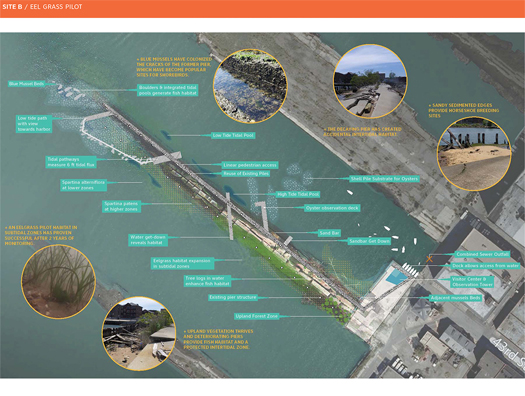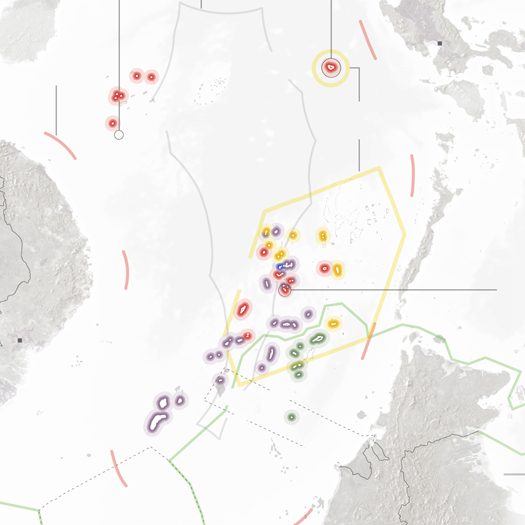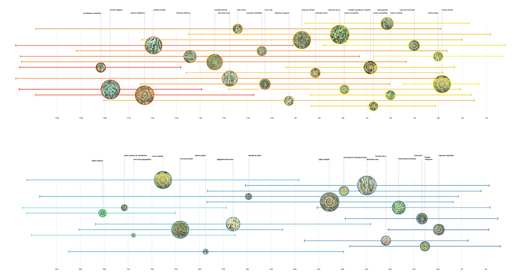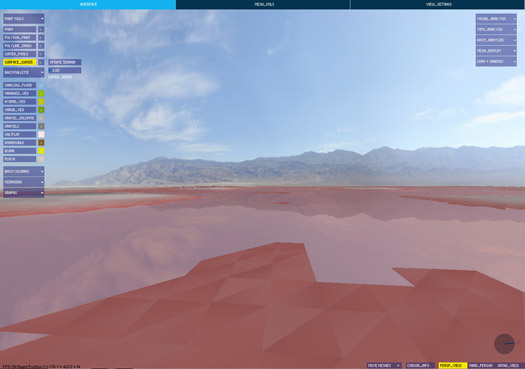
asides excluded – mammoth // building nothing out of something

dredge research collaborative: live interview @ studio-x


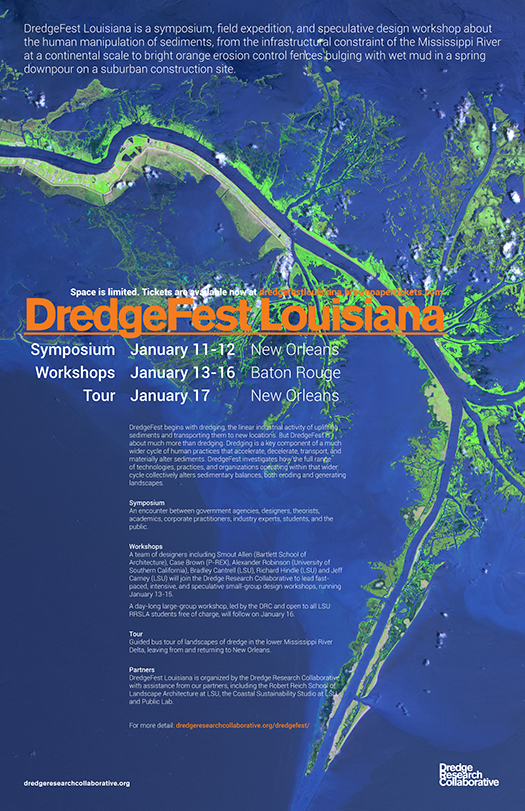
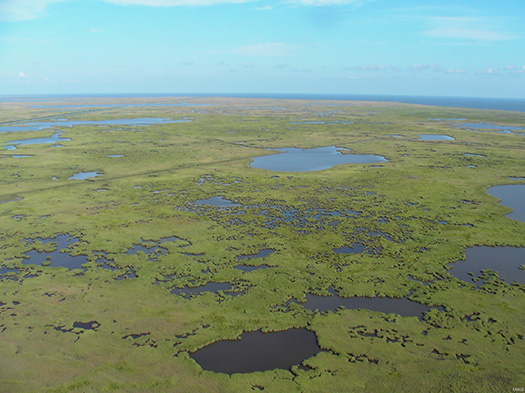
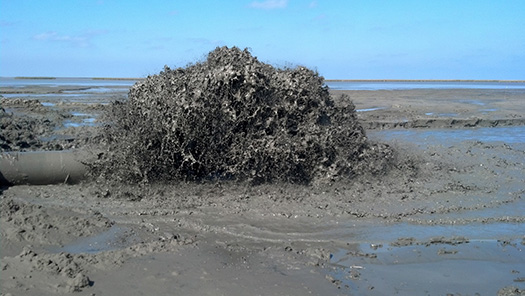
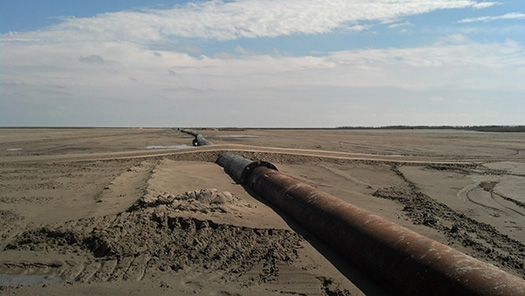
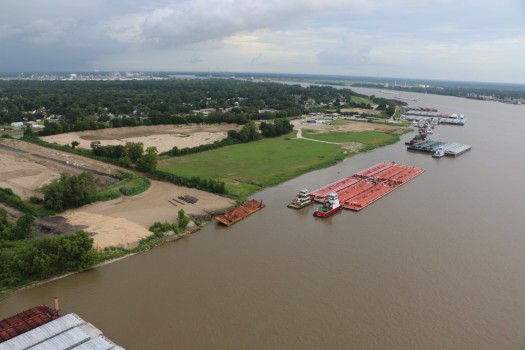
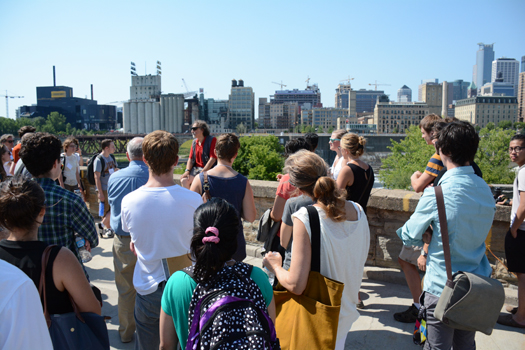
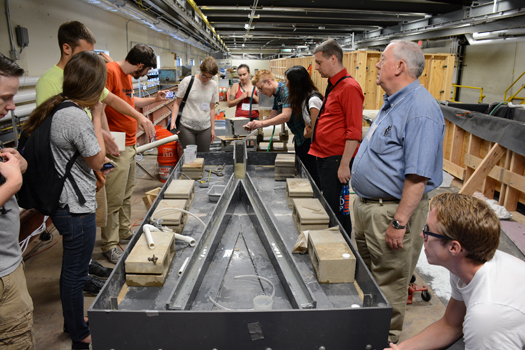
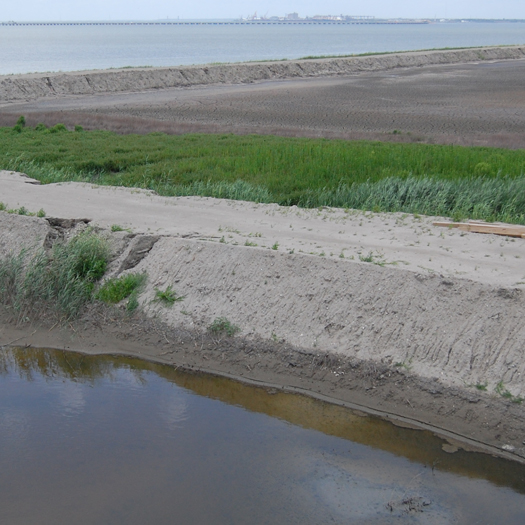
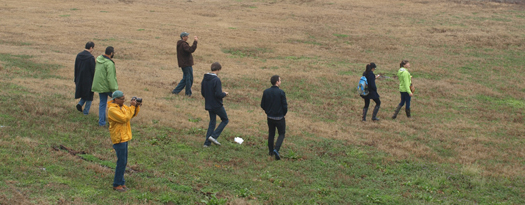
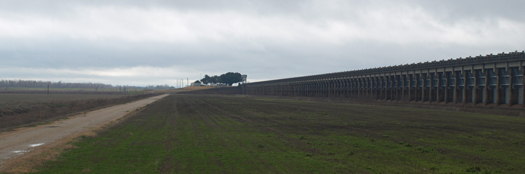
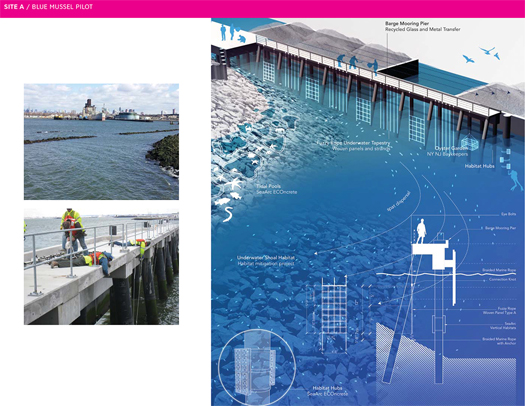
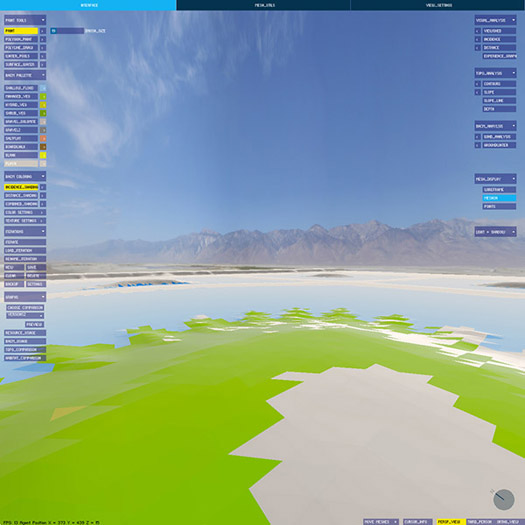
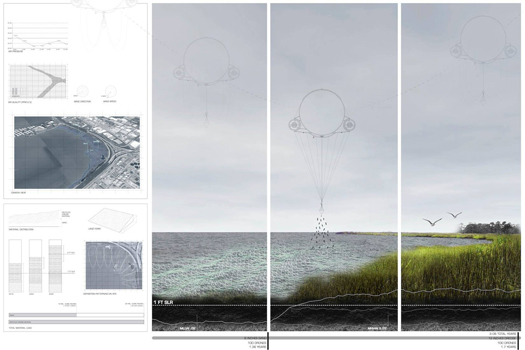
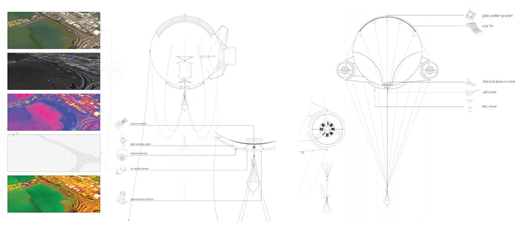
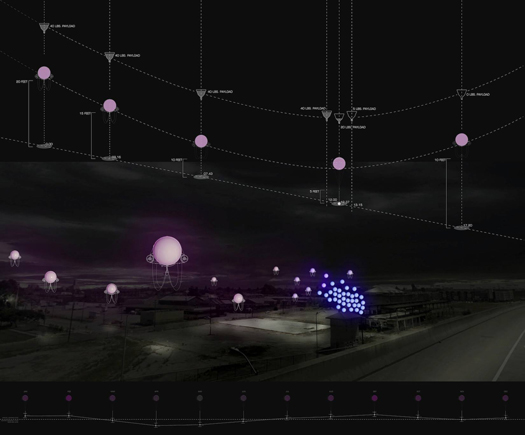
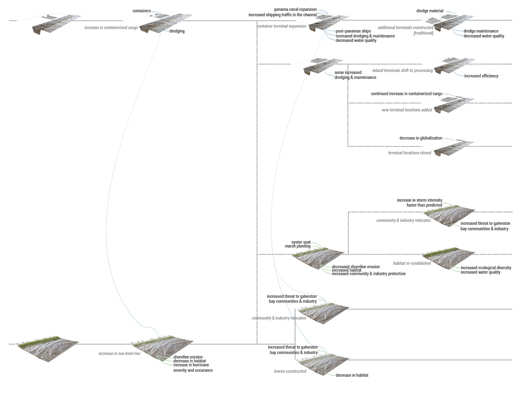
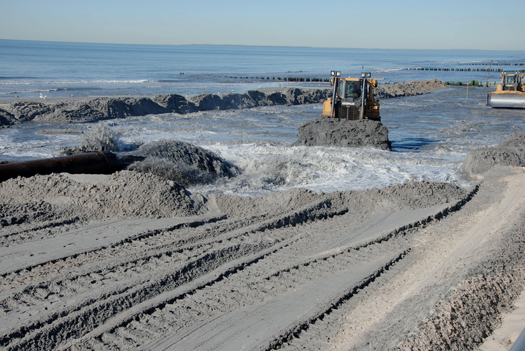
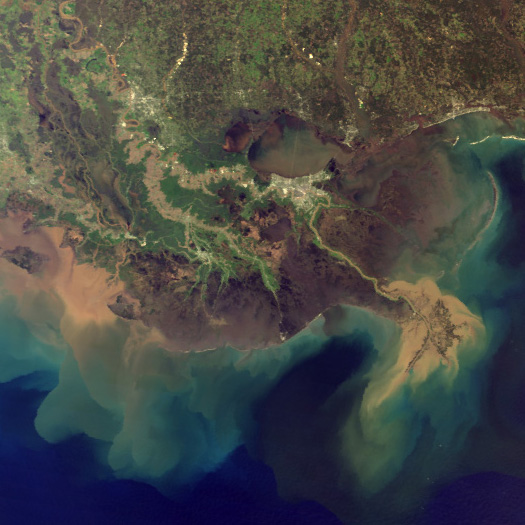
[The Dredge Research Collaborative -- Stephen, Tim Maly, and myself, with fourth member Brett Milligan present in spirit but not body -- in live conversation back in January at Studio-X NYC about the dredge cycle, artificial islands, geotubes, sensate geotextiles coating aqueous terrain, the scale of human influence over sediment, the New York Bight's "Mud Dump Site", other landscapes of dredge, and the potential involvement of the design disciplines in the territories affected by anthropogenic sediment handling practices. As we mentioned then, we're planning to be back in New York, again with Studio-X, for a longer event this fall, where we'll talk to organizations operating on and designers designing for the landscapes of dredge, as well as getting out into and exploring those landscapes (by boat!). Further details will be forthcoming.]

glitch jam


[The Placer County Courthouse, in Auburn, California -- imagine it swarmed by a glitch jam.]

NPR reported this morning on a traffic jam in California caused by an algorithmic glitch “accidentally summon[ing] 1,200 people to jury duty on the same morning”. An excellent reminder of the tendency of algorithmic dysfunction to manifest as physical dysfunction, and (at a relatively small scale) of the potentially disproportionate impact of glitches when they are translated from dataspace into an infrastructural system. The glitch may be as simple as having accidentally swapped the 0 indicating “do not come in” for the 1 indicating “come in”, but the resulting jam is rendered in aluminum autobodies and on asphalt corridors where it is much more difficult to clear than it was to create.

minus extraction


[Miami's Lake Belt, the zone in which the city of Miami becomes a mirror image of itself -- reflected in blue polygons induced by the mining of the limestone rock literally used to construct the city -- before it disintegrates into the Everglades.]

I’ve gotten part way through listening to the portions of last weekend’s Landscape Infrastructures symposium that have been posted online, and was particularly struck by comments that Charles Waldheim made in the closing roundtable:

“I was struck by Neil Brenner moderating the second panel [as he] brought it to a close by saying something to the effect of “the idea, the model, that somehow our action around urbanism should concentrate in the cities, is an outdated notion”.

That struck me as correct, and, at the same moment, if that’s true, it has enormous implications for those of us in [the GSD] and in these disciplines. If in fact we should focus on urbanism and urbanization and its infrastructure, not necessarily focused on the city and an opposition between the city and the externality of biological process, it strikes me that there’s an equally profound paradigm shift potentially for us in landscape architecture. I think, you know, for the better part of the last half-century, in our field, we’ve been operating under a paradigm in which nature exists outside of human agency, the kind of classical if not modernist defintion of ecology, in which urbanization was the problem. And having said that, what I’ve heard over the course of the last twenty-four hours, is that we need to fundamentally re-think that paradigm. [In terms of] the practices that we engage in, the models and habits of thought, the tools, the representational tools that we have available, to be able to think through our commitments, both to social and cultural production, but equally to environment and ecology, absent the idea of our extraction from those natural systems.”

This seems a profoundly important point for landscape architecture, in particular: that urban and natural systems are inextricable, not opposed. Indeed, that they have always been, though the scale of that intertwinment is rapidly accelerating. (If that inextricability seems obvious, it is also important to recognize that an understanding in which natural and urban systems are not just in conflict but fundamentally exclusive has been, as Waldheim notes, the primary paradigm within environmental land planning for at least a half-century.)

One consequence of this is that density and urbanism should not be conflated as if they were always one and the same thing. Density, rather than being the primary characteristic that determines whether a place counts as urban or not (a definition which produces endless pointless arguments about exactly how dense a place must be to be urban), is merely one of the important effects of processes of urbanization. It is a peculiarly important effect in any number of ways — economically, ecologically, phenomenologically –  but it should not be mistaken for an essential characteristic of urban terrain.

This is supported (as we’ve noted before, after Christopher Grey) by the definition that Ildefons Cerdà provided for urbanism when he coined the term: “the science of human settlements at various scales and times, including countryside networks”. It’s not terribly far from “countryside networks” to “landscape infrastructures”, is it?

Another really interesting thing, related to both Waldheim’s point and the de-conflation of density and urbanism, is what this indicates about where opportunity lies for landscape architecture as a discipline. While much progress has been made by firms like MVVA and Field Operations in finding roles (leading roles, even) for landscape architects on projects within the envelope of density, it seems to me that the more stretched the scale of an urban network becomes, the more it becomes uniquely suited to design by landscape architects. Put concretely, there are vastly more square miles of land in, say, the artificial watershed of Los Angeles than there is spare open land in Boston’s city limits; and what other design discipline is used to working with so much land? An expanded definition of urbanism quite literally has more room for landscape architecture.

unknown unknowns

0. Everyone’s favorite Donald Rumsfeld quotation: “[T]here are known knowns; there are things we know we know. We also know there are known unknowns; that is to say we know there are some things we do not know. But there are also unknown unknowns – there are things we do not know we don’t know.” (As evidence that this is everyone’s favorite Donald Rumsfeld quotation, I submit that (a) it has its own Wikipedia page, the wonderfully-titled “There are known knowns”, where debate over its profundity or lack of profundity is documented, and (b) that Rumsfeld himself titled his autobiography Known and Unknown.)

Tetrapods deployed off the Japanese coast near Toyama (top) and Niigata (bottom). An old article in the New York Times reports:

“‘The [Japanese] construction state is in some respects akin to the military-industrial complex in cold-war America (or the Soviet Union), sucking in the country’s wealth, consuming it inefficiently, growing like a cancer and bequeathing both fiscal crisis and environmental devastation,” Gavan McCormack, a professor of Japanese history at Australia National University, wrote…

In the [1990s], public works spending has been stepped up even more to stimulate a languid economy…

…Japan uses as much cement each year as the United States, despite having only half the population and only 4 percent of the land area.”

The tetrapod — a concrete coastal armament used to solidify coastlines and arrest erosion — is symbolic of this metastasized public works state, as there is little constituency opposing their placement and thus tetrapodding typically proceeds more quickly than other projects, so that roughly half of the Japanese coastline has been so armored.


1. GAMES
Last December, I had the pleasure of sitting on the jury for the final reviews of Jorg Sieweke’s landscape studio at UVa, which was exploring various design scenarios for a hypothetical shift of the Mississippi River from its current course to the course it “naturally” desires to take through the Atchafalaya Basin. (This was particularly enjoyable given that I’d accidentally spent the summer blogging about flooding in general and flooding on the Mississippi River in particular.)

[0] I think this set of problems is occurring concurrently in the broader/parallel world of architectural design, so, throughout this post, I’ll shift between talking about architectural design and talking about landscape design, without being particularly clear about boundaries between those two things. Of course, that’s what we usually do here.

One of the student projects proposed a kind of abstracted board game which attempted to codify the interactions between the insurance industry, various economic activities in the Atachafalaya Basin (such as gambling), floods, disaster management systems, public space, and citizens of the flood-prone Basin. This project intrigued me greatly — but it did so less because of its resonance with the recent vogue for “gamification” (where I am inclined to agree, for the most part, with Ian Bogost), and more because it helped me articulate a set of problems related to aggregation, complexity, perversity, and misalignment in the design of landscapes0.

The soils of the Southeastern Piedmont — from Alabama to Virginia — suffered terrible erosion as a result of short-sighted agricultural practices in the 18th, 19th, and early 20th centuries. The prevailing agricultural economic systems of that region during those times — slavery and share-cropping — both encouraged short-sighted practices, as the men and women working farms and fields did not own the land, and so had little incentive to care for its long-term health, even as farming techniques that would have arrested or prevented erosion were well-known.

David Montgomery’s fascinating Dirt: The Erosion of Civilizations recounts the travels of the British geologist Charles Lyell through the antebellum South:

“[Lyell] stopped to investigate deep gullies gouged into the recently cleared fields of Alabama and Georgia. Primarily interested in gullies as a way to peer down into the deeply weathered rocks beneath the soil, Lyell noted the rapidity with which the overlying soil eroded after forest clearing. Across the region, the consistent lack of evidence for prior episodes of gully formation implied a fundamental change in the landscape. “I infer, from the rapidity of the denudation caused here by running water after the clearing or removal of wood, that this country has always been covered with a dense forest, from the remote time when it first emerged from the sea.” Lyell saw that clearing the rolling hills for agriculture had altered an age-old balance. The land was literally falling apart.

One gully in particular attracted Lyell’s attention. Three and a half miles west of Milledgeville on the road to Macon, it began forming in the 1820s, when forest clearing exposed the ground to direct assault by the elements. Monstrous three-foot-deep cracks opened up in the clay-rich soil during the summer. The cracks gathered rainwater and concentrated erosive runoff, incising a deep canyon. By Lyell’s visit in 1846, the gully had grown into a chasm more than fifty feet deep, almost two hundred feet wide, and three hundred yards long. Similar gullies up to eighty feet deep had consumed recently cleared fields in Alabama. Lyell considered the rash of gullies a serious threat to southern agriculture. The soil was washing away much faster than it could possibly be produced.”

The top image is soil erosion in Mississippi (not, of course, in the Atlantic Piedmont — but sharing the same economic systems), photographed by Evans Walker in 1936 and via the Library of Congress; the bottom image is soil erosion on a farm in Caswell County, North Carolina, photographed by Marion Post Walcott in 1940 and also via the Library of Congress. The image at the top of this post is, of course, Charles Lyell’s illustration of the gully described above, reproduced in Dirt.

2. CRASHES
A series of talks that I’ve listened to in the past year also helped frame these problems for me. The first is an interview on Terragrams with Case Brown, currently of P-REX; the second, Kazys Varnelis’s “A Manifesto for Looseness”; and the third, Kevin Slavin’s “Those algorithms that govern our lives” (or, the somewhat shorter TED version, “How algorithms shape our world”). To explain how they’re relevant to the set of problems within landscape design I’m after, I think it’s best to take them in reverse order.

[1] The last time I mentioned Slavin’s talk, it was with an interest in both of these effects, or maybe the point at which these two effects intersect, as I described my interest in the physical geography of global financialization.

The central thesis of Slavin’s talk is roughly that programmed algorithms — embedded in and running financial systems faster than humans can react, controlling Roombas, determining price points on Amazon — are participating in the construction of a world that is increasingly designed to suit them and encoded with their logic. This has a pair of weird effects: first, algorithms begin to manifest physically (James Gaddy, describing Slavin’s talk, writes “he describes a fiber optic canal that was dug between New York and Chicago to deliver stock market information microseconds faster, and the way buildings are being carved out from the inside to house trading servers”) and second — and of more interest to me here – algorithmic systems have the tendency to exhibit suddenly bizarre behaviour, like an algorithm on Amazon.com pricing an unremarkable used book at $23 million1. Algorithmic systems are thus prone to the kind of sudden and unpredictable bifurcations that Manuel DeLanda describes in the introduction to A Thousand Years of Nonlinear History, switching with little apparent warning from a seemingly stable state to something considerably more extreme or erratic:

“Ilya Prigogine revolutionized thermodynamics in the 19060s by showing that the classical results were valid only for closed systems, where the overall quantities of energy are always conserved. If one allows an intense flow of energy in and out of a system (that is, if one pushes it far from equilibrium), the number and type of possible historical outcomes greatly increases. Instead of a unique and simple form of stability, we now have multiple coexisting forms of varying complexity (stable, periodic, and chaotic attractors). Moreover, when a system switches from one stable state to another (at a critical point called a bifurcation), minor fluctuations may play a crucial role in deciding the outcome.”

We might say that algorithmic systems, because of they follow programmed rules strictly, are prone to rapidly becoming far from equilibrium.

Kazys Varnelis’s “A Manifesto for Looseness”, meanwhile, addresses the way that complex systems are, despite — or maybe really because of — their sophistication, vulnerable to crashes. Talking about the research of sociologist Charles Perrow, Varnelis says:

“…creating tightly coupled systems, very complex, finely tuned, highly efficient systems, in which one part’s operation is closely dependent on another’s, and when we add all these together, we can achieve remarkable levels of efficiency. The result is that these systems, because they are so integrated, can fail in unpredicatable ways. One part fails — a sensor — this has a cascading effect on another part, which exceeds its tolerances. This makes another part fail; and so on, and so on. This leads to anomalous readings on a number of sensors. Operators can’t figure out what’s going on; personnel become overwhelmed. They don’t understand what’s happened; they make the wrong decisions. Things get worse. Nobody knows what to do… Three Mile Island, Chernobyl, Fukushima, the Challenger disaster, the Columbia disaster… Don’t blame the operator — blame the complexity designed into the system itself.”

The algorithmic systems that Slavin describes are, obviously, a subset of complex systems generally and, insofar as they occasionally have something like an operator (though an important part of Slavin’s thesis is the argument that algorithms are increasingly defined by our general inability to comprehend or ‘read’ the ones that shape our world), the operator clearly cannot be faulted for failing to react with algorithmic speed to the actions of the algorithmic system. The kind of cascading failure that Varnelis describes by way of Perrow is, it seems to me, a perfect example of what a rapid bifurcation where “minor fluctuations… play a crucial role in deciding the outcome” looks like, played out in real time. And that minorness — the smallness of the critical fluctuations within the overall scale of the system — is precisely what makes them difficult for the operator to predict, anticipate, or even observe. (Replace “operator” with “designer” in that last sentence, and you’ll have a hint of where I am going with this.)

Third, I mentioned Case Brown’s interview on Terragrams: Brown is principal researcher for P-REX and, most relevantly here, recent recipient of the Rome Prize in landscape architecture, where he studied the Roman villa system, “the ancient… agricultural complex that spread the empire, fed the armies and grew the surpluses to make senators rich” as an early example of a real estate bubble:

“The rise and crash of the Roman villa system reads eerily like the modern story of American foreclosures — profit schemes of land speculation, securitized and excessively mortgaged properties, rapid expansion and even more rapid decline.  … As a system, they provide a marvelous example of combining a food economy infrastructure and an elite leisure system, all the while staking claim to an enormous empire. How did this economy operate and did the Romans overextend their land ventures as many have in the modern United States?” Brown asks.

He said it is the nature of these markets to bloat beyond their own means, and the tendency continues today with such examples as oversized American vacation homes, elaborate golf course communities in China or ambitious skyscrapers in Dubai.

“We tend to overextend markets with gluttonous consistency. All these forms of extra-urban development, ancient and modern, draw on a common set of market-exploitation tendencies. Fertile land, urban respite and profit have provided the skeleton for centuries of speculation. To be able to document the birth of this trifecta could reformat our current landscape speculative practices,” Brown said.

Here, in a speculative system, the collapse is perhaps a bit more predictable than within the algorithmic or complex system — with every bubble, there are those who recognize the bubble before it collapses — but the result is the same: a disastrous and typically sudden crash. In all three kinds of systems, I think, crashes can be said to originate with the actions of individually rational parts acting, in aggregate, in accordance with perversely misaligned incentives. The algorithm, for instance, is based on a model of the “real” world (“real” being in quotation marks because the algorithm is, of course, as real as anything else), and when that model is even just slightly misaligned with the world it models, the aggregate nature of algorithms — algorithms always flock — produces outcomes that are rapidly perverse: $23 million used books, “flash crashes”.

An empty street grid (top) and unfinished residential towers (bottom) in Ordos, the coal boomtown in Inner Mongolia made famous by a 2009 Al Jazeera report describing it as “China’s empty city”, its growth propelled by a heady mixture of new wealth generated by the coal boom, local state policies responsible for planning and providing infrastructure for a huge new city in the desert, and national state policies that opened up real estate speculation as one of the few investments available to private individuals; images via google maps.

3. DISTRIBUTION, AGGREGATION, AND DISAGGREGATION
Returning to the studio I reviewed at UVa: there were several other projects, in addition to the one explicitly referencing game design, that struck me as broadly representative of a trend in architectural design (and particularly landscape architecture) towards proposals that rely on aggregation and distributed components to drive beneficial change. For instance, one proposed distributing the functions of rainwater control and freshwater supply to individual units located on each city block and shared by the inhabitants of that block; another set up a system for collecting fecal matter and turning it into productive soil, again on a small scale, and with collection incentivized by small scale economic rewards (“bring your morning shit, get a morning cup of coffee”). Typically, I think, what such proposals have in common is that they design distributed systems that rely on incentive structures to guide individual actors towards making individually rational decisions with collectively beneficial consequences. (In that, these proposals might be understood as something like neoliberal architectural design, with neoliberal intended here to be simply descriptive, neither derogatory nor laudatory.)

These kinds of proposals are increasingly common: witness the proliferation of projects hoping to find some alternate use for vacant lots at a city-wide scale or the vogue (particularly in student work, which I take as an indicator of future disciplinary trends) for “tactics” (the (genuinely excellent) GSD student publication “Tactical Operations in the Informal City” is typical of this vogue: “the students were asked not to develop a master plan for the whole city, but rather to propose one or two interventions that could initiate a chain reaction of improvement”). A reliance on distributed components and aggregated effects is even making in-roads into surprising places, as in the case of the New Urbanism’s enthusiastic embrace of “Tactical Urbanism” (though, if there is anything consistent about the New Urbanism, it is that it has remained enduringly flexible as an ideology, seeking to co-opt and absorb counter-movements, as Duany wrote in a fascinating article for Metropolis last April that I’ve always intended to write at more length about), an embrace which has been well-received in and amplified by the broader urbanist community on the internet (see, for instance, the chord that the Atlantic Cities‘ coverage of a so-called “guerilla wayfinding” project in Raleigh struck).

And mammoth has both often praised projects in this vein — such as Visual Logic’s excellent Backyard Farm Service or, in our “Best Architecture of the Decade”, where we claimed Kiva as an architectural actor — and proposed them ourselves. (For that matter, the projects I’ve referred to from the studio at UVa were — in no small part due to their participation in the project of distributed design — among the stronger projects in that studio.) Rhetoric surrounding the incorporation of resilience as a primary goal into design — rhetoric which we have encouraged — also typically promotes the dissolution of centralized structures into networks of smaller components which will function in aggregate towards some goal. (I also think this interest extends beyond human actors, towards harnessing the aggregate behaviors of variegated non-human actors like tides, clasts, markets, microbesbrick-laying drone helicopters, and alligators.)

[2] I also find it intriguing that both studio work and the practice of architectural design have a certain meta-resonance with games. That is, studio and practice could both be understood as games — structured sets of rules that aim to map reality that nonetheless exhibit disconnects with the reality they map at various points — even if both studio work and practice tend to have more sophisticated rule systems than the vast majority of games, which makes it harder to notice those disconnects. In both cases, it is interesting to note what is included and what is excluded from the game.

So I intend to phrase my concern here within the context of a deep appreciation for the merits of the general project of distributed design which, at its best, offers a more democratic, more organic, and more resilient alternative to heavily centralized, fracture-prone strategies. But I am wondering: when designers set up complex systems reliant upon the alignment of incentives to channel the swarming and flocking behavior of aggregate wholes towards beneficial ends, is there any thought going into the potential of that very same kind of behavior to magnify small mis-alignments into major crises – mis-alignments that may have been so small as to be invisible to the original designer or which (worse) the original designer may have had her own incentives to ignore? What would be the landscape effect equivalent to the weird behavior that happens at the margins of a video game — or a financial crisis? Where does aggregated behavior cascade through glitches into perverse results2? Where do individually rational behaviours become collectively irrational? What are the dangers in assuming that everything goes according to plan?

Cropland in Iowa, whose land use is thoroughly dominated by agriculture — roughly ninety percent of the state’s land is in use for agricultural production, and more of that land is cropland than in any other state (well, at least by this source; I’ve also seen indications that it might be Nebraska). While Iowa’s land was originally converted into cropland by settlers attracted by a fertile combination of climate, soils, and topography, the current dominance of that land use can at least partially be attributed to federal subsidies, particularly for corn and soybean production, which tilt market dynamics in favor of farming cash crops. Thus Iowa might be said to be an agricultural freakology (the ecoregion it is in is named not for a defining natural feature — like the “Northern Glaciated Plains” or “Mississippi Valley Loess Plains” — but for the crop that dominates it: “Western Corn Belt Plains“), sustained in part by the perverse misalignment of incentives.

4. SAFEGUARDS
If the misalignment of incentives is an obvious potential problem with design that relies on directing aggregate behavior through incentives, then there is an obvious need for safeguards — for structures within a design proposal that will contain the risk of cascading failures.

Thus I suggest that these projects should anticipate failure, which (ironically? I guess?) indicates that they should be particularly concerned with systemic resilience. That is, they should be designed not to finely-tuned limits of tolerance, but with enough give that they can withstand the accidents, perversions, and even crashes that will inevitably result from the misalignment of incentives in unpredicatable ways. Furthermore, they should explicitly acknowledge the presence of “unknown unknowns”. While it is logically impossible to anticipate specific unknown unknowns, it is quite possible to anticipate misalignment and perversity generally. The tendency, I think, in making these kinds of proposals — and this is very much what Stephen and I did in our proposal for Luanda, for instance — is to construct proposals on the basis of best-case scenarios, considering only first-order failures, where first-order failure is defined as the problems that the project responds to and second-order failure is defined as the problems that are potentially generated by the proposed response. In a way, this suggests that designers need to become better futurists, though that may often mean being a futurist at relatively small temporal and spatial scales.

If architects and landscape architects accept that it is probably impossible to set up perfectly aligned incentive structures, but still want to take advantage of their potential, then we’ll need to have mechanisms in place to protect against misalignments that we know are both unpredictable and inevitable. There’s a lot of talk about what those mechanisms look like in the financial world, for example; what would they look like as a component of the design proposal or design initiative?

[Parts of this post emerged out of conversations with Stephen, Brian Davis, and Brett Milligan; in particular, Brett suggested the example of Iowa as an unnatural ecology produced by misaligned incentives. As noted in one of the footnotes, this is all closely related to my interest in the landscapes of global financialization -- which are typically spectacular case-studies in the landscapes thrown off by the misalignment of incentives -- and so, if you enjoyed this piece, you might want to also check out Metro International Trade Services.]

expiration dates


[Chart showing the typical lifespans of a wide variety of infrastructures (and components of infrastructures), from treated wood ties to deep geological repositories for high-level radioactive waste. The descriptive text reads:

"This chart visualizes the lifespans of equipment associated with waste, water, energy, and transportation systems across North America. As we approach -- and pass -- the breakdown point for many post-WWII urban infrastructures, important questions emerge. What and how should we rebuild? How do we build in the face of dynamic climates and coastal hazards? Should we design for permanence or for failure? Should we build stronger or weaker structures? Can natural systems be coupled with technological facilities? Cross-disciplinary action by ecologists, urbanists, historians, geographers, and engineers is necessary as we construct the next generation of public works projects for an era of unprecedented change and uncertain risk."

The chart is on the flipside of the poster advertising this weekend's "Landscape Infrastructure" symposium at Harvard GSD; poster design is by OPSYS/Alexandra Gauzza. For more detail on the symposium, which is this Friday and Saturday in Cambridge, see mammoth's earlier post. Click here for a larger (and properly-oriented) image.]

stable borders

My wife pointed me to a short but very interesting piece on NPR last night, about the re-surveying of the line between North Carolina and South Carolina:

JULIE ROSE: Way before there was GPS, years even before the Revolutionary War, surveyors on horseback drew the line between the colonies of North and South Carolina. Every mile or so, they made a slash on a tree and took notes – hickory here, chestnut there – standard practice for the time, but not so helpful in 2012.

ALEX RANKIN: We’ve worked the whole length of the survey, and to our knowledge, none of those trees exist 200 and almost 50 years later.

ROSE: Alex Rankin owns the Charlotte area engineering firm hired to help retrace the steps of those original boundary markers. The effort spans 334 miles from the Atlantic to the Appalachians and has cost the states nearly a million dollars. Without those original trees for guidance, Rankin’s team turned to matching up the edges of historic property deeds.

RANKIN: What we’re doing is simply discovering where the state line is. It is where it is.

ROSE: But that’s certainly not how it feels to Karen Byrnes. Just look at the document she signed when she closed on her home and 5 acres in 2006.

KAREN BYRNES: You know, it clearly shows that our home is in York County. And so now, they’re saying that the line has moved and now our house is in Mecklenburg County.

ROSE: York County is South Carolina. Mecklenburg is North Carolina.

BYRNES: We would not have purchased the home if it had been zoned Mecklenburg County or North Carolina.

ROSE: Byrnes prefers South Carolina’s lower taxes and schools for her 9-year-old son. Rather than switch residency, she’s listed her house for sale, even though she worries it will be worth less now that it’s in North Carolina. State officials working to retrace the boundary say about 93 properties appear to have discrepancies, concentrated in the highly developed Charlotte region. Some, like the Byrnes family, suddenly find themselves in a different state, but most are like Natalie Everett.

NATALIE EVERETT: I have a South Carolina neighbor and a North Carolina neighbor.

ROSE: And she just found out the state line splits her house.

What’s so fascinating here is that the act of surveying is actually producing increased uncertainty.

This is because the conflict here isn’t between a set of actors who want the border to remain where it is and a set of actors who want to adjust the border, but between two different understandings of what it would mean for the border to remain in place.  For the people living along the border, the border is (quite reasonably) defined by habit and custom: it is where they’ve always thought and acted like it is, which means that ultimately they understand the border to be constructed by the accumulated opinion of property owners.  For the states, though, the border is a legal entity, defined by the recording of its position in legal documents, and consequently a thing out there in the world, waiting to be excavated and clarified.

And with that in mind, you can see that the sentence I wrote above — “the act of surveying is actually producing increased uncertainty” — is only accurate if you accept the border residents’ point of view (which, again, is quite reasonable); from the states’ point of view, the survey is not producing anything, only revealing an existing conflict between practice and reality, because, for the state, the description of the border in a set of historical property deeds is more real than any other description of the border.

density


[NASA compares Manhattan to a neutron star. The infographic is a dimensional comparison -- if scaled for density instead, Manhattan wouldn't be visible. From wikipedia: "[the] density [of a neutron star] is approximately equivalent to the mass of the entire human population compressed to the size of a sugar cube”; link via Alex Ogle.]

drylands design conference


[The Colorado River Basin as a hydrological mega-object; image by the Commonwealth Approach project team: Alex Gonski, Rob Holmes, Rebecca May, and Laurel McSherry.]

I mentioned a little while ago that Laurel McSherry and I would be presenting our work on “The Commonwealth Approach” at the Arid Lands Institute’s Drylands Design Conference near the end of March. I thought I would post the official conference announcement:

The Arid Lands Institute at Woodbury University, in partnership with the California Architectural Foundation (CAF), hosts the Drylands Design Conference from March 22–24, 2012 on the Woodbury University campus in Burbank, California. Shifts in the economy, demographics and climate are causing westerners to rethink the centralized, energy-intensive water systems of the 20th century. Retrofitting the West: Adaptation by Design brings together architects, landscape architects, artists and engineers with leading environmental thinkers, scientists, and renowned conservationists to debate a range of design strategies for the future. More than 225 educators, design professionals and students are expected at the conference where the arid and semi-arid west will be re-examined as a vast field of opportunities for water-smart design innovation at a range of scales, from building systems to infrastructure and landscape spaces.

The Drylands Design Conference kicks off with an opening reception at the Architecture + Design Museum (A+D) in Los Angeles on Thursday, March 22. On view at the museum is Drylands Design, featuring selected work from CAF’s William Turnbull Drylands Design Competition (www.drylandscompetition.org). The exhibition showcases work by architects, landscape architects, engineers, artists, and urban designers responding to the challenges of water scarcity in the face of climate change. With a focus on the US West, the exhibition presents a portfolio of adaptive strategies large and small, rural and urban, high tech and low-carbon. Since no single solution will meet the complex needs of the US West, the exhibition explores a range of approaches for how buildings and parks, houses and streets, industry and agriculture, cities and neighborhoods might adapt to a water-stressed future. Following its run from March 22-April 26, 2012, the exhibition is scheduled to travel in the US and abroad.

In an innovative cross-disciplinary collaboration, ALI and UCLA’s Institute of the Environment and Sustainability provided technical and policy advising to five research award winners chosen from the CAF William Turnbull Drylands Design Competition. At the conference on Friday, March 23, the five award-winning teams will present their design proposals and discuss the policy implications they suggest.

These design case studies and the panel discussions they inform raise important questions about de-coupling energy and water, localizing resources, restructuring watershed governance, the scaleability of small systems, the relationship between water infrastructure and public architectures, and the role of the arts and design in shaping a working public landscape.

The conference puts both young and established design leaders in dialog with thinkers from an array of disciplines, including Wiliam DeBuys, Ph.D., writer and conservationist, author of seven books, the most recent A Great Aridness; Paul Bunje, Ph.D., Managing Director, Los Angeles Regional Collaborative for Climate Action and Sustainability, supported by the UCLA Institute of the Environment and Sustainability; Stephanie Pincetl, Director, Center for Sustainable Urban Systems, UCLA; James Workman, award-winning journalist and author of Heart of Dryness; and Barry Taylor, Ph.D., Professor at Fuller Theological Seminary and Art Center College of Design in Pasadena, California.

On Saturday March 24th, design educators are invited to a workshop on interdisciplinary methods for advancing Drylands Design regionally and globally.

Schools, NGOs, and design firms are encouraged to engage the conference from remote locations by subscribing to live-streaming.

Full details about the conference can be found here, including registration.

visibility


["The Digital Dump", a graphic about e-waste from Good.is's "Transparency" series and Column Five Media.]

Mostly for our own purposes (keeping track of things we see), we’ve started Visibility, a tumblr collecting items related to An Atlas of iPhone Landscapes. I make no promises about how frequently it will or won’t be updated, but if you’re particularly interested in the topic, you can follow the tumblr or grab the feed.

eight-bit baroque

Via BLDGBLOG, Timo Arnall’s “Robot Readable World”, “an experiment in found machine-vision footage, exploring the aesthetics of the robot eye”:

This video is rather obviously fantastic, but I do think it’s worth calling attention to a perceptive comment left on the Vimeo page. Arnall describes the video as exploring the questions “how do robots see the world?” and “how do they gather meaning from our streets, cities, media, and us?”, which is obviously in-line with the line of inquiry set up by Matt Jones (like Arnall, of BERG) in his talk (well worth reading) on the robot-readable world, which explores “the evolutionary pressure of… three billion (and growing) linked, artificial eyes on our environment”. The comment that I mentioned, though, from Greg Borenstein, notes that the video, while it certainly succeeds in exploring the aesthetics of the robot eye, is perhaps not in fact so directly interacting with the question of “how robots see the world”:

I keep thinking about whether these are equivalent to the Terminator HUDs that Slavin mocks (images.wikia.com/terminator/images/2/25/T-800a_Threat.jpg). Why would a computer communicate to itself with text? These visualizations are really for the human observer of the CV process. They’re akin to Rodney Brooks’s idea of language having been invented by god to make it easier to read our minds. In this case these graphics give a window on the extent to which the CV algorithms are seeing the world the way we want them to, whether their vision agrees with ours. It’s not an internal representation, it’s a performance for our benefit. Like Kyle, find myself doing a dance of rapidly connecting the displays with the semantics of what they represent: arrows for flow, boxes for blobs, etc. These graphics were designed by people to be seen by other people. They’re meant to let us see how the algorithm is doing. It’s only an internal state of the computer to the extent to which conversing is mind reading.

Insofar as the aesthetic (or “new aesthetic”) of this robot-readable world is not, in fact, a purely robotic aesthetic, but rather a translation of the algorithmic “reasoning” of these robots into a visual language that makes their reasoning human-readable, I find that this makes Manaugh’s suggestion of a “landscape architecture for machines” at least partially composed of “future gardens optimized for autonomous robot navigation” all the more intriguing, as an intermediary aesthetic that sits between the robot and the human might be the perfect aesthetic for constructing baroque vegetative monuments to the robot-readable world: Vaux-le-Vicomtes of comfortably pixelated topiaries, to be enjoyed by both the Google Car and Sergey Brin. (It’s worth noting here that the French Baroque is typically understood as embodying an interest in demonstrating the imposition of human Order on floral Nature, which also suggests some precedent for a Robot Baroque, monumentalizing the literal interface between the human and the robot.)

[Also worth reading -- BLDGBLOG's speculations on "object cancers", or a "kind of robot-blocking world" as a "corporate response to the robot-readable world.]

munitions landscape


[The Radford Army Ammunitions Plant on the New River, in southwest Virginia.]

FASLANYC takes us on a tour of particularly bizarre militarized landscape typology — the World War II-era munitions plant, beginning with the Radford Army Ammunitions Plant in southwestern Virgina. Digging into the archives at the Historic American Landscapes Survey, Davis excavates the fascinating generative logic governing the spatial patterns of these sites:

Buildings used in the first stage of the process, where the material handled is highly flammable but not explosive, are grouped together in a section known as the “cotton area.”  Those used in the second stage, where the material handled is highly explosive, are widely spaced and form what is called the “powder line.”  Material is conveyed from one building to another first by flumes, then by motor trucks, and finally- when the highly explosive stage is reached- by small hand carts.

… From here on a unique type of construction, adapted to handling explosive materials, is required.  All of the buildings in the powder line make use of “blow out” construction designed to control the direction of an explosion through one or more extremely light screens which will “blow-out” with a minimum increase in the air pressure within the building.

A second method of limiting the effects of explosions… is used in the solvent recovery buildings and those in the finishing area, which are spaced from all other buildings and from each other and surrounded by barricades.  Spacing varies according to the maximum amount of explosive which is to be processed or stored in the building at any one time.

Barricades are constructed of heavy timbers with a plank face on each side and a screened dirt fill, making a solid wall with an average of approximately 5-foot thickness to absorb the shock of any possible explosion.  Their height roughly corresponds to the height of the buildings they surround.

Read more at FASLANYC. As he suggests, this adds an important twist to the study of militarized landscapes — expanding beyond demilitarized zones, cities under permanent siege, and military abandonia to include the industrial landscapes that literally fuel the production of those other places.

an atlas of iphone landscapes


[MMG Century, in northwest Queensland -- the world's second-largest zinc mine, owned and operated by the Chinese metals conglomerate China MinMetal. MMG Century features prominently in the talk below.]

1 Note that if you are reading this indirectly, i.e. on Google Reader, you may not see the video below.

1. A conversation the other day reminded me that I never posted the talk I gave at Visualizar last summer. This happened, I think, both because I have a bunch of half-written posts about the other (really interesting!) content of the seminar and because I’ve had some intention of providing the text from the talk along with the video. But since I clearly am not going to get around to either of those things anytime soon, it seems like I should go ahead and post the video1.

The talk is an extension of one of my favorite posts, a preliminary atlas of gizmo landscapes, which attempted reconsider the iPhone, not as a discrete, independent hand-held device (“the phone that magically has the internet in it”, which I think is more or less how Apple wants you to think of it), but as a networked object that both produces and is produced by a wide array of distant and not-so-distant landscapes, from zinc mines to Fed-Ex distribution hubs. The talk starts off a bit slow, maybe, as I probably spent more time than most viewers will want explaining how I thought this line of research fit into the wider task of the seminar, but I still think it’s pretty interesting, especially once the tour of iPhone landscapes gets going. (Basically, if you’re bothering to read mammoth, you’ll probably enjoy the talk.)

2. Relatedly, the iPhone’s manufacturing chain — what I call the iPhone’s landscapes of manufacture and assembly in the atlas talk — has been the subject of several recent news stories.

This American Life’s excellent “Mr. Daisey and the Apple Factory” begins with an excerpt from Mike Daisey’s one-man show about his trip to Shenzhen — which began when Daisey saw a few photos of the inside of an iPhone factory, and was shocked by the absence of robots. Once in Shenzhen, Daisey works out a plan to get inside the factory zone:

“And two days later we head out into the factory zone. As we come to each factory, Kathy briefs me on what it is they make and what it is I have said I am going to buy. The factories are all different, but really they’re more similar than different. There’s always gates and guards. When you get past those, there’s always a lawn, big and green and plush. No one walks on it. No one uses it. You go into the lobbies. The lobby is these huge empty Kubrickian spaces, totally empty except for a tiny little desk for the receptionist.

And you cross the huge, empty lobby to the tiny little desk. You introduce yourselves, and then the executives always come down in a gaggle, all together. They pick you up, and you go up together to a conference room.

After the PowerPoint, we head down to the factory floor, industrial spaces with 20,000, 25,000, 30,000 workers in a single enormous space. They can exert a kind of eerie fascination. There’s a beauty to industrialization on such a massive scale. You don’t have to deny it. There’s a wonder to seeing so much order laid out in front of you. And people are walking around, whispering statistics in your ear.

It’s easy to slip into a kind of Stalinist wet dream, but I try to subvert that by locking onto actual faces. They take me up and down the aisles. And the first thing I notice is the silence. It’s so quiet. At Foxconn you’re demerited if you ever speak on the line.

At no factory I went to did anyone ever speak on the line, but this is deeper than that. As a creature of the First World, I expect a factory making complex electronics will have the sound of machinery, but in a place where the cost of labor is effectively zero, anything that can be made by hand is made by hand. No matter how complex your electronics are, they are assembled by thousands and thousands of tiny little fingers working in concert. And in those vast spaces, the only sound is the sound of bodies in constant, unending motion.

And it is constant. They work a Chinese hour, and a Chinese hour has 60 Chinese minutes, and a Chinese minute has 60 Chinese seconds. It’s not like our hour. What’s our hour now, 46 minutes? You know, you have a bathroom break, and you have a smoke break. If you don’t smoke, there’s a yoga break. This doesn’t look anything like that. This looks like nothing we’ve seen in a century.”

The excerpt from Daisey’s show is followed by reporting that confirms what Daisey saw in Shenzhen. You can listen to the piece online here (there’s also a transcript, if you prefer to read), or download it from the iTunes store (ironic!) for a nominal fee.

Second, the CEO of Foxconn, Terry Gou, seems determined to correct the perception that his company dehumanizes its workers, as Business Insider reports:

“According to WantChinaTimes, Terry Gou, the head of Hon Hai (Foxconn), the largest contract manufacturer in the world, had this to say at a recent meeting with his senior managers: “Hon Hai has a workforce of over one million worldwide and as human beings are also animals, to manage one million animals gives me a headache,” said Hon Hai chairman Terry Gou at a recent year-end party, adding that he wants to learn from Chin Shih-chien, director of Taipei Zoo, regarding how animals should be managed.

As WantChinaTimes put it, Gou “could have chosen his words more carefully.” But Gou had indeed invited the zoo director to speak to Hon Hai’s top managers in the hope that the zoo-keeper’s advice would help them do their jobs better.”

Charming.

Finally, the New York Times ran a lengthy piece on “Apple, America, and a Squeezed Middle Class”, which explores Apple’s decision to relocate the bulk of its manufacturing operations from the United States to China over the past decade:

“Though components differ between versions, all iPhones contain hundreds of parts, an estimated 90 percent of which are manufactured abroad. Advanced semiconductors have come from Germany and Taiwan, memory from Korea and Japan, display panels and circuitry from Korea and Taiwan, chipsets from Europe and rare metals from Africa and Asia. And all of it is put together in China.

In its early days, Apple usually didn’t look beyond its own backyard for manufacturing solutions. A few years after Apple began building the Macintosh in 1983, for instance, Mr. Jobs bragged that it was “a machine that is made in America.” In 1990, while Mr. Jobs was running NeXT, which was eventually bought by Apple, the executive told a reporter that “I’m as proud of the factory as I am of the computer.” As late as 2002, top Apple executives occasionally drove two hours northeast of their headquarters to visit the company’s iMac plant in Elk Grove, Calif.

But by 2004, Apple had largely turned to foreign manufacturing. Guiding that decision was Apple’s operations expert, Timothy D. Cook, who replaced Mr. Jobs as chief executive last August, six weeks before Mr. Jobs’s death. Most other American electronics companies had already gone abroad, and Apple, which at the time was struggling, felt it had to grasp every advantage.

In part, Asia was attractive because the semiskilled workers there were cheaper. But that wasn’t driving Apple. For technology companies, the cost of labor is minimal compared with the expense of buying parts and managing supply chains that bring together components and services from hundreds of companies.

For Mr. Cook, the focus on Asia “came down to two things,” said one former high-ranking Apple executive. Factories in Asia “can scale up and down faster” and “Asian supply chains have surpassed what’s in the U.S.” The result is that “we can’t compete at this point,” the executive said.”

This is a particularly interesting supplement to the component of my talk that touches on manufacturing because while I focused on Longhua Science and Technology Park — the FoxConn factory-city in Shenzhen — and the kind of place that it is for those who live and work in it, the Times article explains that the appearance of Longhua, which I described as “the iPhone city”, required the disappearance of  another city, back in the United States. (This makes it a similarly good supplement to the This American Life piece, for the same reason.) There’s a huge set of issues tied up in the relationship between Longhua and Elk Grove, as the article indicates, from the ethics of labor conditions to the rise of logistics landscapes as the key node in global trade chains to the disappearance of the manufacturing jobs that formed the foundation of the American middle class (and corresponding “job polarization”).

(A second article in the New York Times series on the “iEconomy” is similar in theme and content to the This American Life show, looking at the “human costs to workers” of iPad manufacture.)


[A snapshot of "Laptop Computer" by user Leo on Sourcemap.]

3. Another related note: James Bridle recently posted a link on his “New Aesthetic” tumblr to the above map, which is intended to lay out the supply chain involved in the production of a typical laptop computer. (The same user who created that map, “Leo”, also has a nice map for the “material composition of a mobile phone circa 2006″.)

The site that this map is hosted on, Sourcemap, describes itself as “the crowdsourced directory of product supply chains and carbon footprints”, which makes it a sort of broad-based platform for the creation and distribution of exactly the kind of industrial material genealogy that I tried to perform with the iPhone in my talk. Which is to say that I think it is a fantastic idea.

schafran on race and foreclosure

Speaking of the geography of financialization, Alex Schafran had a fantastic post at Polis last December on race, foreclosure, and rhetoric surrounding the “death of the fringe suburb”.

In forthcoming work done with my colleague Jake Wegmann, analyzing real-estate data in the region since 1988, we can show that the zip codes to which African Americans migrated were doing well in terms of median home value until 2005, long after the migration had begun. Not just well overall, but well against San Francisco’s Cole Valley, one of the most gentrifying places around. Their presence in the fast growing portions of deep suburbia did not cause the crisis, and their decision to move made sense. If you were black and middle class, moving to places like Antioch and Patterson seemed like a good deal — a chance at a piece of the American pie and a rational economic decision. Nobody realized how shaky the terms of the deal would turn out to be.

This is one of the many reasons that Chris Leinberger needs to change his tune. I agree that sprawl was a bad idea, that growth on the fringe helped bring the economy down and that urban centers are the heart of our global future. We’ve known this since suburbanization began in earnest two generations ago. But we failed to stop it.

Now the “fringe” in Northern California alone is home to millions. And in the 24 Bay Area cities [analyzed by Schafran], almost half a million of the 850,000 residents are not white. These are generally hard-working families who followed the same suburban path the white masses went down a generation or two ago — except much farther from city centers and with worse debt, less job security and no real mass transit. This is a generational raw deal hatched at every scale of our urban development.

The foreclosure crisis is a national tragedy that hand-wringing about the failures of sprawl will not undo. Predicting the “death of the fringe suburb” is reminiscent of the harmful language used to describe cities in the days before urban renewal, when we labeled the neighborhoods of the working classes and communities of color as “slums” and “ghettos,” bulldozing what we could and redlining the rest. This massive and exceptionally racist failure of urban policy in the post-war era laid the groundwork for this crisis more than a half century ago. While we were busy destroying inner cities and building nice suburbs, we denied African Americans the right to move out as well.

Schafran’s post is well-worth reading in full, particularly for the compelling maps he has produced.

Why is this a landscape whose origins can be traced at least in part to financialization? There are a number of reasons, including the disproportionate impact of public-sector austerity (and accompanying job losses) on the African-American middle class that Schafran refers to, the general hunger for exurban expansion produced by the reliance of the various invented products at the heart of the financial crisis — collaterialized debt obligations, credit default swaps, and so on –on a steady supply of new homes and fresh mortgages, the role of the financial sector in foreclosure fraud, and the ties between the mortgage market and the shadow banking system.

[Friend-of-the-blog Peter Nunns also wrote about Leinberger and Schafran's posts. Also, earlier posts on mammoth in defense of understanding suburbia and on the American home as a (now-busted) machine for making money.]

dry commonwealths

[The eighty-six proposed "commonwealths" of the lower forty-eight states, from "The Commonwealth Approach".]

1 I can’t take too much credit for our win — we borrowed the main idea from a pair of earlier competition entries Laurel produced.

I’m excited that “The Commonwealth Approach”, an entry to the Arid Lands Institute’s Drylands Design Competition that I worked on with Laurel McSherry1, has been selected for a research prize by the competition jury. Taking a bit of inspiration from John Wesley Powell, we proposed re-organizing the political geography of the United States, beginning with the replacement of the fifty states with ninety-three “commonwealths” whose borders are based on water resource geography. Our paragraph on “geography and bias” explains part of the motivation behind this seemingly impractical proposal:

“Political geography — the location of bureaucracies, the subdivision of a nation into smaller units, the position of symbolic power centers like the U.S. Capitol — biases decision-making.  In the United States, and with specific reference to water, the position of the federal government, its siting in the District of Columbia on the eastern edge of the continent, produces a bias against understanding the full consequences of the aridity of the half of the nation that lies west of the 100th Meridian.

This political geography constitues an organizational architecture which precedes, constrains, and produces site architecture.”

One of the nice things about this award is that, unlike many competitions where the winning entries are selected and never developed any further, the research prize gives us the opportunity to progress our design research over the next couple months, towards public presentation as a component of the Drylands Design Conference at Woodbury University in Burbank at the end of March.

Consequently, this post is just a bit of a tease — a much fuller report will be forthcoming after we’ve finished our current work.

The other eight winning entries, including four more research award winners and various honor and merit awards, can be found on the Drylands Competition website.

metro international trade services


[Warehouse at 1200 E McNichols Road, Highland Park, Michigan. The small red sign at the bottom right corner of the second image says "Metro".]

The warehouse above — and a network of others like it, scattered around the industrial abandonia of Detroit — is a crucial bottleneck in the global aluminium trade.

Before I explain how this is, though, a bit of background.

1 Kevin Slavin’s fantastic talk “How algorithms shape our world”, which I’m hoping to write something a bit longer about soon, would be a classic of that genre.

2 One of the things that makes that corporeality important is that, while much of the systemic perversity of financialization — like, say, the creation of synthetic CDOs — is intentionally obscure, the perversity of the landscapes that arise from financialization is often obvious, as the case of Metro International Trade Services will, I think, make clear.

3 Alexis Madrigal (author of the linked “flash crash” articles) also wrote about a similar case of “bizarre robot traders”:

“Mysterious and possibly nefarious trading algorithms are operating every minute of every day in the nation’s stock exchanges.

What they do doesn’t show up in Google Finance, let alone in the pages of the Wall Street Journal. No one really knows how they operate or why. But over the past few weeks, Nanex, a data services firm has dragged some of the odder algorithm specimens into the light.

The trading bots visualized in the stock charts in this story aren’t doing anything that could be construed to help the market. Unknown entities for unknown reasons are sending thousands of orders a second through the electronic stock exchanges with no intent to actually trade. Often, the buy or sell prices that they are offering are so far from the market price that there’s no way they’d ever be part of a trade. The bots sketch out odd patterns with their orders, leaving patterns in the data that are largely invisible to market participants.”

Something that I’ve become increasingly interested in the past year — and consequently am collecting a series of related items I hope to post — is the physical geography of global financialization1. I think my interest comes from roughly the same place that my interest in the material infrastructure of the internet (and other hertzian spaces) does — recognizing that, like the internet, global financialization is obviously non-corporeal and, at the same time, less obviously but quite importantly corporeal2. (By corporeal in these cases, I mean both sustained by a complex network of physical infrastructures and generating various indirect physical products through influence within economic, social, and political systems). Financialization is also, like the internet, a thing that exists only in aggregate, its behavior governed by the interaction of a myriad of smaller parts which are directed by a multiplicity of potentially conflicting desires. As a consequence, both things — financialization and the internet — have extremely jagged edges, weird dark spots where aggregated lower-level behaviors manifest as bizarre meta-behaviors. As an example, the intersection of those two sets of dark spots is particularly weird: like last May’s “flash crash”, where “a single large sell order executed by a rather crude software program sent the already-stressed market into a downward spiral”, causing the Dow to drop “10 percent in just minutes”3.

But given that my interest is particularly in the moments where those weird behaviors are spatialized, finding form in buildings and landscapes, this post exists, as I suggested earlier, to highlight a specific point in the physical geography of global financialization: the Detroit warehouses of “Metro International Trade Services”.


[4815 Cabot Street, Detroit, Michigan.]

I was reminded of this peculiar company by the recent news that big banks — the global players from the financial crisis that are household names, like Goldman Sachs, J.P. Morgan, and Barclay’s — have been threatening to block the sale of a much less widely known organization, the London Metal Exchange. To explain why those banks, which own large shares in the LME, would want to prevent the sale of the London Metal Exchange, you have to understand what Metro International Trade Services is, and something of its materially bizarre business model:

“In a rundown patch of Detroit, enclosed by a cyclone fence and barbed wire, stands an unremarkable warehouse that investment bank Goldman Sachs has transformed into a money-making machine.

The derelict neighborhood off Michigan Avenue is a sharp contrast to Goldman’s bustling skyscraper headquarters near Wall Street, but the two operations share one important element: management by the bank’s savvy financial professionals.

A string of warehouses in Detroit, most of them operated by Goldman, has stockpiled more than a million tonnes of the industrial metal aluminum, about a quarter of global reported inventories.

Simply storing all that metal generates tens of millions of dollars in rental revenues for Goldman every year.”

3 The London Metal Exchange has a simple and legitimate reason for warehousing:

“The LME certifies and regulates the Detroit sheds as part of a global network of more than 640 warehouses. The network is meant to even out swings in volatile metals markets. During recessions, surplus metal can be stored until economies recover and demand picks up, when the metal can be released.”

But — rather problematically — “that function is now being undermined by the backlog in Detroit” — as Goldman Sachs drives up prices by releasing as little metal as it legally can.

So the way that the business model works is essentially this: through its subsidiary Metro International Trade Services, Goldman owns these Detroit warehouses which are stuffed with this vast quantity of aluminum — as the article at Reuters says, more than a million tonnes, a quarter of global inventories. The stuffing, though, is done by the London Metal Exchange3, which owns the metals in the warehouses, and consequently Goldman Sachs ends up making a great deal of money off the rent that the London Metal Exchange pays to Metro International Trade Services — even though Sachs is one of the major owners of the London Metal Exchange. (Goldman bought the warehousing company in 2010, in a wave of purchases of metal warehousing companies by global financial institutions seeking to use the rising price of physical commodities as a hedge against their poor performance in commodity trading.)


[13542 Helen Street, Detroit, Michigan.]

Meanwhile, as Goldman is collecting huge rents from the London Metal Exchange off its stockpile of aluminum, American aluminum buyers are starved of the metal they want to purchase:

The long delays in metal delivery have buyers fuming. Some consumers are waiting up to a year to receive the aluminum they need and that has resulted in the perverse situation of higher prices at a time when the world is awash in the metal.

“It’s driving up costs for the consumers in North America and it’s not being driven up because there is a true shortage in the market. It’s because of an issue of accessing metal … in Detroit warehouses,” said Nick Madden, chief procurement officer for Atlanta-based Novelis, which is owned by India’s Hindalco Industries Ltd and is the world’s biggest maker of rolled aluminum products. Novelis buys aluminum directly from producers but is still hit by the higher prices.

Madden estimates that the U.S. benchmark physical aluminum price is $20 to $40 a tonne higher because of the backlog at the Detroit warehouses. The physical price is currently around $2,800 per tonne. That premium is forcing U.S. businesses to fork out millions of dollars more for the 6 million tonnes of aluminum they use annually.

4 When producers fear a slowdown, they go to banks — like Goldman — to finance metals: “in a typical financing deal, a bank buys metal from a producer, agrees to sell it at some future point at a profit, and strikes a warehouse deal to store it cheaply for an extended time period.”

But, because of an archaic rule system under which the London Metal Exchange specifics minimum daily metal release requirements by the city rather than by the warehouse (“at the moment, a warehouse operator needs to deliver just 1,500 tonnes a day per city, whether it owns one warehouse there or dozens”), Goldman has every incentive to concentrate the physical position of the aluminum it is storing in a single city — Detroit. This is because the less metal is released, the more money Goldman makes, primarily off the rent on its warehouses, but also potentially on the commodities exchange4. On the other end, the London Metal Exchange gets a one percent take of all rents in all the warehouses it approves, which hardly incentivizes the Exchange to adjust its release rules, even failing to account for the fact that Goldman owns a large portion of the Exchange.

And that’s why a quarter of the world’s supply of “available aluminum” is sitting in warehouses in Detroit, warehouses which are “a whirl of activity in the early hours of the morning when metal is usually delivered for storage”, but deserted throughout the rest of the day — because the aluminum goes in, but it only very slowly comes back out.

[I originally came across the story of Metro International Trade Services in this post by Umair Haque.]

dredge @ studio-x nyc

We’re excited that we’ll have the opportunity in a couple weeks to do a live interview at Studio-X NYC:

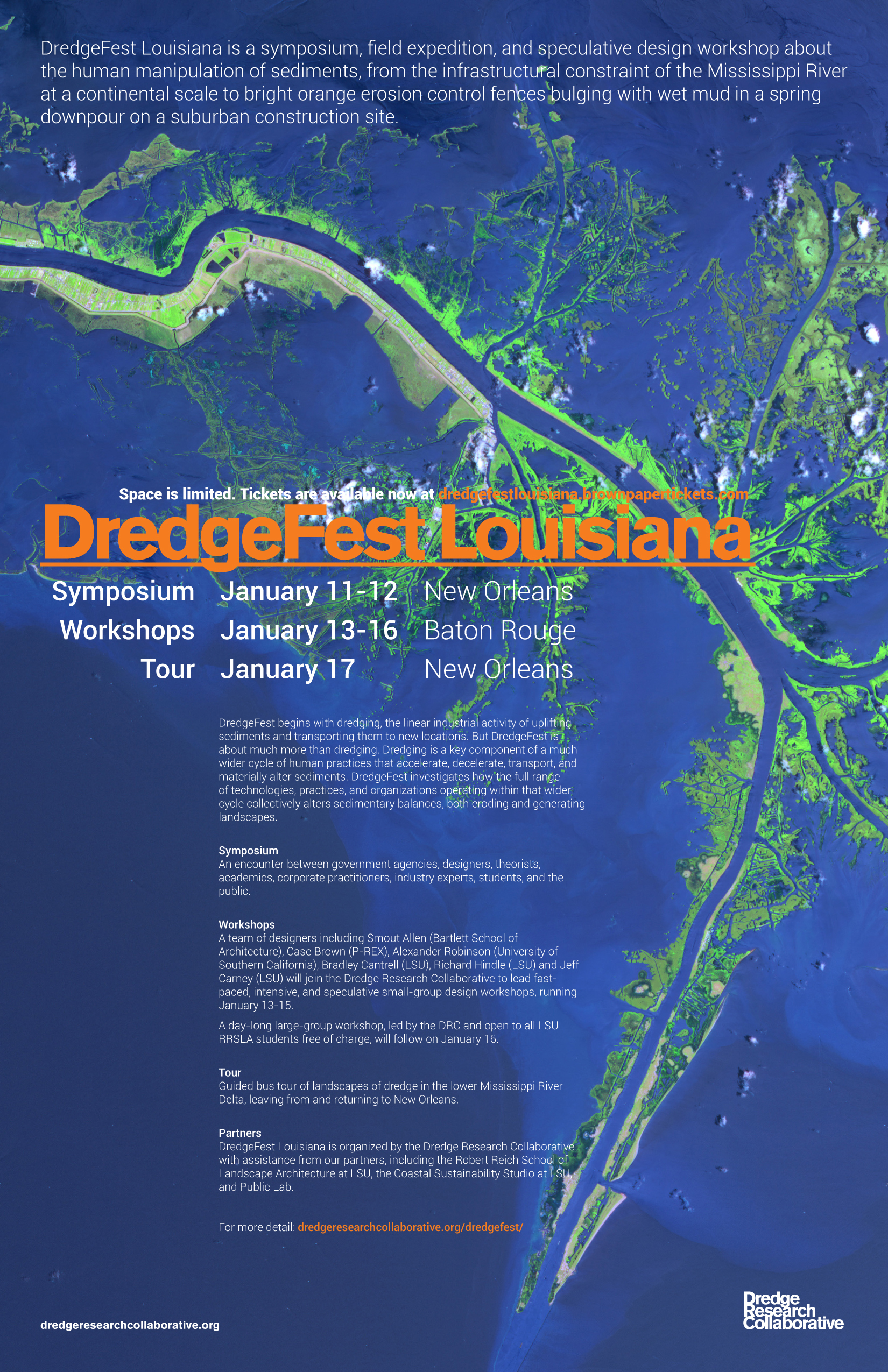
For the first LI@SX of 2012, Studio-X NYC is delighted to welcome Rob Holmes and Stephen Becker of Mammoth and Tim Maly of Quiet Babylon, three-quarters of the Dredge Research Collaborative (with Brett Milligan of Free Association Design), for a short visual tour of hulking geotubes, silt fences, sensate geotextiles, and other monuments of the dredge cycle, followed by a lively Q&A and informal discussion on the unrecognized architectural possibilities of dredge.

While dredge is commonly considered a linear act of industrial engineering — a dredging machine arrives at a site, sucks up a great quantity of sediment, and deposits that sediment on some other site — we argue that dredging is better understood as a component of a wider network of anthropogenic sedimentary processes which generate a fascinating array of interconnected landscapes.  Fluid topographies are restrained by bright orange silt fences; dredging barges continuously empty shipping channels which are promptly re-filled with sediment disturbed by upstream farms and new subdivisions; sensate geotextiles monitor the stability of landscapes they are literally embedded in; hulking geo-tubes lay engorged with dredged sediments in streams on Filipino golf courses and along Mexican beaches and on the coastal dunescape of Virginian spaceports.  Silts, sands, and clays flow rapidly between these landscapes in liquid suspension, linking them and re-shaping the earth’s surface.  Collectively, the choreography of these landscapes embodies a vastly quickened counterpart to conventionally defined geologic cycles — the Dredge Cycle.

The Dredge Cycle is landscape design on a deliriously monumental scale, but unrecognized as an architecture. So far, it remains the domain of logistics, industry, and engineering, a soft successor to the elevated freeway interchanges and massive dams that captured the cultural imagination of the previous century, a new infrastructural vernacular for the self-aware Anthropocene.

At Studio-X, we’ll be talking both about what extant landscapes of dredge are like, and what potentials for design intervention they might offer.  The event, which is on January 24th from 6:30 pm to 8:30 pm, is free and open to the public; Studio-X NYC is 180 Varick Street, Suite 1610.

The evening’s conversation will serve as a prelude to a limited-ticket Festival of Dredge tour this summer, for which LI@SX attendees will be given reservation priority — look for more details on the Festival in the future.

everyday structures

Recommended reading: Alan Wiig’s “everyday structures”, a blog “explor[ing] the place of infrastructure in the urban landscape”, with a particular focus on “Hertzian space” and digital communications infrastructure. Wiig is studying geography at Temple University, so his blog most typically deals with landscapes in Philadelphia or its surrounds. Like many of mammoth‘s favorite things at the moment, “everyday structures” deals with the quotidian material conditions of landscape, posting both readings from Sanford Kwinter or Henri Lefebvre and snapshots of Pelton wheels or a homeless camp juxtaposed with broadband lines. In a recent conversation with a couple other landscape architects, I noted that I think geographers are, in many ways, doing a better job of conceptualizing landscape than landscape architects, particularly with relation to infrastructural conditions in the networked city — Wiig’s blog is an excellent example of that.

[Image at top is from the post "fiber along the road" on "everyday structures".  Wiig captions -- and I quote the full caption because it is the combination of image and caption that makes the typical snapshot on "everyday structures" fascinating -- "Automobiles turning, the fiber optic cable runs parallel to the road. Marlton Pike West, in the Garden State. That little white and orange marker in front of the "SO Cornell Ave -->" and "ALL TURNS -->" signs indicates the Internet and other forms of digital communication are flowing alongside the automotive and pedestrian traffic on this route."]

dharavi: globalization and spontaneously mixed uses


[The following piece, on the surprising ways that the residents of the Mumbai settlement of Dharavi have integrated that urban agglomeration into global economic networks, and the value of the unique spatial formatting that both enables and results from that integration, is the second thoroughly-footnoted guest post we've run from Peter Nunns. (The first was "fecal politics".) After being on hiatus during the time when we published that first post, Peter is blogging again at Read after Burning.]

“The slum-dwellers,” he adds, “are experts at live-work space design. They spontaneously do mixed-use! We just have to learn from them.” [1]

When homes are also considered places of work – either unpaid housework or paid industrial homework – then the industrial geography of the city assumes new meanings. [2]

1 Mason 2011

2 Sassen 2001: 261

3 Patel and Arputham 2007, Fernando 2009

4 UN 2006: 37

Dharavi has been described as “Asia’s largest slum”. Between 600,000 and 1 million people live in 85 dense neighborhoods clustered on 2.4 square kilometers of low-lying, marshy land in the heart of Mumbai [3]. (Mumbai’s total population was estimated at 18.2 million in 2005 by UNDESA (2010).) It is one of the most overcrowded areas of Mumbai – and one of the worst-served by infrastructure. Dharavi contains an estimated 1,440 people for each toilet seat, meaning that “streets, lacking drainage, become channels for filthy water carrying human excrement” during the rainy season [4]. In many respects, it has become a byword for urban squalor and poverty.

5 Nijman 2009

6 Grant and Nijman 2003: 474

7 Patel 2010

8 Chalana 2010: 31

9 Benjamin 2008: 721

It’s also a chunk of incredibly valuable real estate. The relaxation of foreign investment rules brought an influx of capital into Mumbai in the 1990s, and land prices skyrocketed [5]. The city’s central business district was “the most expensive in the world” in the mid-90s, while “residential real estate prices spiralled up as well, in part in response to the influx of money from nonresident Indians” [6]. Dharavi, which lies between two of the main rail lines, with close access to the new financial district and the international airport [7], has been describes as the “Opportunity of the Millennium” for developers [8]. Remaking Dharavi would open up new territory for foreign direct investment and globally-linked industries that would benefit from proximity to the international airport and CBD. In the words of Solomon Benjamin, it would exorcise the “spectre of cities besieged by cancerous slums” by putting a “modernist spin on attracting economic development: ‘Bangalore transforming into a Singapore, Bombay [Mumbai] into a Shanghai, and Delhi into a London’!” [9]

10 Chalana 2010, Patel and Arputham 2007

11 The anticipated cost of the redevelopment rose to US $3 billion in the wake of the 2008 financial crisis.

12 Patel, Arputham, Burra and Savchuk 2009

The Dharavi Redevelopment Project (DRP), first proposed in 1996 by Mukesh Mehta, an American-trained architect working in Mumbai and started in 2004, is the latest attempt to capitalize upon inflated land values. It is intended to mix slum upgrading with the development of new office space and housing for Mumbai’s upper and middle classes [10]. The $2 billion DRP [11] calls for Dharavi to be divided into five zones, each of which would be designed and constructed by a separate property development firm. Residents who could prove their occupancy prior to 1995 (later extended to 2000) would be offered apartments on the same sites or new locations in exchange for their land [12]. A portion of profits from the sale of newly-constructed housing and commercial space would be used to finance upgraded housing for Dharavi’s low-income residents, while the rest would be returned to the city government and private developers.

13 Sanyal and Bhattacharya 2010, Nijman 2009

The purpose of the DRP is to globalize Mumbai; to create the sorts of “internationally competitive” living spaces and commercial areas required by globally-mobile businesses and workers in the “knowledge economy”. But this program ignores Dharavi’s actually-existing ties to the broader urban and global economies. The slum houses a wide range of informal enterprises that are integrated into globally disaggregated assembly lines through subcontracting arrangements. While we tend to think of slums as a form of low-income housing, Dharavi’s economic role is at least as important. Its living spaces often double as informal and unregulated production spaces – like many slums, it is a “spontaneous” form of mixed-use design [13].

14 Nijman 2009: 10, Fernando 2009

15 Sanyal and Bhattacharya 2010: 163

16 Nijman 2009: 10

17 Patel and Arputham 2007: 505

Roughly 70 to 80 percent of Dharavi’s residents work within the slum – an unusually high ratio compared with many other Indian slums [14]. It contains at least 5,000 industrial enterprises, which produce textiles, pottery and leather, jewellery, food products, and so on and so forth [15]. Its southwest corner “has a major cluster of plastic recycling factories, with some estimates of well over 500 units,” while many streets are “lined with retailing, food stands, kiosks, taxis, small restaurants, some hotels, etc.” [16]. These industries “provide incomes and livelihoods for hundreds of thousands of Mumbai citizens who would otherwise have no employment” [17]. Because they also entail a number of negative externalities – low wages, unsafe conditions, and high levels of air and water pollution – they rely upon the existence of flexible, unregulated space in the city center.

18 Fernando 2009

19 Sanyal and Bhattacharya 2010: 163

20 Harriss-White 2010: 131

Work done in Dharavi is a crucial part of the city’s economy [18]. Patel and Arputham observe that it “probably contributes far more to the Indian economy than most special economic zones.” Its annual turnover has been estimated at between $700 million and $1 billion [19]. And while Dharavi is somewhat unusual in the magnitude and diversity of its industries, it is part of a wider trend in India’s globalizing economy. According to Sudarshan et al, 30 to 40 percent of India’s exports now originate in the informal economy, which “includes entire industrial clusters making goods for export (metalware, machine tools, leatherware, textiles and garments, tools and equipment, and some IT services)” [20]. The expansion of India’s international trade is related to the growth of subcontracting networks and industrial homework.

21 Harriss-White and Sinha 2007, see also Frenkel and Kuruvilla 2002

22 Sudarshan et al 2007: 179

Over the past two decades, the country’s manufacturing sector has undergone parallel processes of upgrading and downgrading: businesses in the formal sector have become more capital intensive, displacing labor-intensive work into the decentralized and more flexible informal sector [21]. According to Sanyal and Bhattacharya, “sub-contracting from large firms to small firms has been increasing and consequently numbers of homeworkers, to whom small firms in turn sub-contract, are also increasing” (see also UNIFEM 2000). In 1999/2000, there were approximately 28 million homeworkers in the non-agricultural labor force, 30 percent of whom were located in urban areas [22]. The bottom reaches of subcontracting networks are predominantly female. Rani and Unni found that in 2000/01, “home-based [production] workers constituted about 81 percent of all female workers and about 46 percent of male workers.”

23 Sanyal and Bhattacharya 2010: 163

As the case of Dharavi demonstrates, these production arrangements also rely upon certain spatial arrangements. Slums are often ideal locations for combining living and work space – a fact that is often not appreciated by redevelopment projects. Consequently, the DRP is doubly problematic for residents: it threatens both their shelter and their livelihoods. Many of the central issues of contention relate to the preservation of Dharavi’s informal industries and mixed-use spaces. As a result, “the Dharavi resistance qualifies more as a ‘labour’ mobilization than slum dwellers’ resistance” [23].

24 Chalana 2010: 31

25 Chalana 2010: 32

The current master plan “entails building the rehabilitation housing zones on less than half of the original land, and allocating only 2 percent of the land to retain ‘‘non-polluting’’ industries” [24]. On the one hand, this would either increase density to an unsustainable level, or displace many of Dharavi’s residents. The project “would likely create additional homelessness, as some estimates suggest that about a quarter of the existing residents would not be eligible for rehabilitation based on the residency requirement,” which provides for resettlement only for households that can prove residency prior to 2000 [25].

26 Sanyal and Bhattacharya 2010: 163

On the other, the DRP proposes to replace existing shelters, which often mix domestic and industrial uses, with small residential spaces in high-rise buildings. As a consequence, the “entire business district as Dharavi is under threat because most of the enterprises do not have licences and so cannot find any place in the new redeveloped Dharavi [26]. Although “non-hazardous and non-polluting” workshops can potentially be rehoused, this will still mean closure of several important industries, such as pottery, leather goods, and recycling, and the loss (or displacement to the urban periphery) of tens or hundreds of thousands of jobs.

27 Patel and Arputham 2007, 2008, Patel, Arputham, Burra and Savchuk 2009, Arputham and Patel 2010

Two community organizations have contested the DRP, moving it into a “zone of negotiation” between inhabitants and city government. In a series of articles published in the academic journal Environment and Urbanization, the leaders of the Alliance have provided regular updates on political negotiations over the project [27].

28 Patel, Arputham, Burra and Savchuk 2009: 244

29 Patel, Arputham, Burra and Savchuk 2009, Chalana 2010

30 Patel, Arputham, Burra and Savchuk 2009: 244

31 Arputham and Patel 2010: 502

To date, residents’ activism has secured several important gains. First, proposed densities have been lowered significantly. New guidelines issued in October 2008 specified a maximum building height of eight or ten stories, as opposed to original plans for 20 to 30 story apartment buildings [28]. The size of rehabilitation apartments for eligible slum-dwellers has also been increased, from 225 square feet to between 250 and 300 square feet [29]. This will, of course, make them more livable – but it will also provide additional space for home-based industries. Likewise, there have been incremental improvements to the space available for work in Dharavi. The original plans called for 50 percent of the floor space offered for sale by developers to be used for upper/middle-class housing [30]. Guidelines released in 2008 specify that 80 percent be available for commercial use – although there are wide variations between the five proposed sectors [31].

The fate of Dharavi is likely to set a precedent for future slum redevelopment projects in India. Activists and developers are closely watching the case of Dharavi: if such a large, economically important space can be redeveloped without significant consultation with residents, it will open the door for similar efforts elsewhere. In their latest update, Arputham and Patel note that the DRP is already being considered as a model for the redevelopment of a 1.1 square kilometre slum adjoining the Mumbai International Airport, which currently houses 85,000 or more households on commercially-valuable land.

I suppose that I’m alluding to two different types of outcome here. The first is a social one – the DRP would make many current Dharavi residents worse off, or at any rate reduce their ability to make choices about the city in which they live. But leaving that aside (and it’s a large thing to set aside!), the DRP may be a flawed project even on purely macroeconomic terms. It’s an attempt to develop Mumbai as a global city that completely runs roughshod over the actually-existing globalization occurring there. In a sense, it’s a struggle over whether a type of informal mixed-use design, and a certain mode of global integration, is allowed to continue within Mumbai.

[On the topic of the DRP, this old Airoots post, which makes a similar argument for understanding Dharavi as a "self-generating post-industrial city", is also worth a read:

The inhabitants of Dharavi have a fantastic capacity to solve their own problems. For many, Dharavi has been a platform for social mobility to middle-classdoom. However, one problem the inhabitants cannot get their head around is the threat of a top down redevelopment plan backed by the state. This burdens the residents of Dharavi more than anything else. Not only does the state not help, it even comes in the way of self-development. Why would anyone invest in their homes or business if it risks being bulldozed in a few months or years?

What seems to separate Dharavi from the DRP more than anything else is a generational gap. In the age of user-generated content, open-source and P2P, the net generation connects intuitively with the archetype of the squatter, who, just like the hacker in another realm, delves in and strives to overcome loopholes leftover by the system, and uses community and social networking as its modus operandi. In fact, it makes total sense to understand Dharavi as a self-generating post-industrial city...

More than a master plan, Dharavi needs a liberation of the imagination. Lets drop the heavy CAD maps and GIS surveys and zoom in to the street level. All Dharavi needs is some creative photoshoping and less of a patronising colonial gaze. If allowed to develop through their own internal skills, if provided for with basic infrastructural and amenities, the hundreds of enclaves, will keep improving their conditions, as they have always done. While no one can imagine what the neighbourhood may look in a couple of decades, it is certain to represent the city’s spirit like nothing else.

Click through for the references for Peter's post.]

References

Arputham, Jockin and Patel, Sheela. 2010. “Recent developments in plans for Dharavi and for the airport slums in Mumbai.” Environment and Urbanization 22(2): 501-504.

Benjamin, Solomon. 2008. “Occupancy Urbanism: Radicalizing Politics and Economy beyond Policy and Programs.” International Journal of Urban and Regional Research 32(3): 719-29.

Chalana, Manish. 2010. “Slumdogs vs. Millionaires: Balancing Urban Informality and Global Modernity in Mumbai, India.” Journal of Architectural Education ?(?): 25-37.

Fernando, Valerie. 2009. “In the Heart of Bombay: the Dharavi Slum.” Available online at esp.habitants.org. Accessed 20 June 2011.

Frenkel, Stephen and Kuruvilla, Sarosh. 2002. “Logics of Action, Globalization, and Changing Employment Relations in China, India, Malaysia, and the Philippines.” Industrial and Labor Relations Review 55(3): 387-412.

Grant, Richard and Nijman, Jan. 2003. “The Re-Scaling of Uneven Development in Ghana and India.” Tijdschrift voor Economische en Sociale Geografie 95(5): 467-481.

Harriss-White, Barbara. 2010. “Globalization, the Financial Crisis and Petty Commodity Production in India’s Socially Regulated Informal Economy”. In Bowles and Harriss.

Harriss-White, Barbara and Sinha, Anushree, eds. 2007. Trade Liberalization and Indias Informal Economy. Oxford: Oxford University Press.

Mason, Paul. 8 August 2011. “Slumlands — filthy secret of the modern mega-city.” New Statesman. Available online at http://www.newstatesman.com/global-issues/2011/08/slum-city-manila-gina-estero.

Nijman, Jan. 2009. “A Study of Space in Mumbai’s Slums.” Tijdschrift voor Economische en Sociale Geografie 101(1): 4-17.

Patel, Sheela and Arputham, Jockin. 2007. “An offer of partnership or a promise of conflict in Dharavi, Mumbai?” Environment and Urbanization 19(2): 501-508.

Patel, Sheela and Arputham, Jockin. 2008. “Plans for Dharavi: negotiating a reconciliation between a state-driven market redevelopment and residents’ aspirations.” Environment and Urbanization. 20(1): 243-253.

Patel, Sheela, Arputham, Jockin, Burra, Sundar and Savchuk, Katia. 2009. “Getting the information base for Dharavi’s redevelopment.” Environment and Urbanization 21(1): 241-251.

Patel, Shirish. 2010. “Dharavi: Makeover or Takeover?” Economic and Political Weekly 45(24): 47-54.

Rani, Uma and Unni, Jeemol. 2009. “Do Economic Reforms Influence Home-Based Work? Evidence from India.” Feminist Economics 15(3): 191-225.

Sanyal and Bhattacharya. 2010. “Beyond the Factory: Globalization, Informalization of Production and the Changing Locations of Labour”. In Bowles and Harriss, eds. Globalization and Labour in China and India: Impacts and Responses.

Sudarshan, Ratna, Vekataraman, Shanta and Bhandari, Laveesh. 2007. “Subcontracted homework in India: A case study of three sectors”. In Mehrotra and Biggeri: 173-209.

UNIFEM. 2000. A Preliminary Study on the Productive Linkages of Indian Industry with Home based Women Workers through Subcontracting Systems in Manufacturing Sector. New Delhi: United Nations Development Fund for Women.

United Nations. 2006. Human Development Report 2006. New York: United Nations Publishing.

United Nations Department of Economic and Social Affairs (UNDESA), Population Division. 2010. World Urbanization Prospects: The 2009 Revision. New York: UN-Habitat Urban Info.

hypothethical signs


[An image from Mehmet Ali Gökçeoğlu's mayoral campaign.]

This past summer on Places, Rob Walker, one of the artists behind the “Hypothetical Development Organization”, penned a brief history of architecture fiction and discussed the even-briefer history of that organization.  (The Hypothetical Development Organization was, if you are unfamiliar with it, a brief initiative which produced “hypothetical futures” for each of ten selected sites in New Orleans, with the proposals unbound “by rules relating to commercial potential, practical materials, or physics”.)  My favorite thing that Walker does in the essay is tracing the essential vein of weirdness that links the fiction produced by the Hypothetical Development Organization to the ordinary and common development signs that inspired the project:

“One day I went for a routine walk. My wife and I live in Savannah, GA, in an area that’s mostly residential, but interspersed with commercial and public buildings. It’s a nice stroll to an excellent bakery, my bank, a convenience store, the main branch of the public library.

Our neighborhood is the sort that people describe as “transitional,” and some of the property, both residential and commercial, is vacant. On one nearby commercial structure, vacant for the four-plus years we’ve lived in the area, I noticed a sign during this particular walk. You’ve seen similar signs, and I’d seen this one probably a hundred times, without ever really thinking about it. It was a rendering of a development, a future, involving a small, empty building. It suddenly struck me that, given how long this sign has been here, what it depicted was, at best, a hypothetical future — and arguably a fictitious one.

Since whenever this sign was first posted, the real estate market has collapsed, the old go-go economy has evaporated, and as it happens this building has been put up for sale. Any development that may take place some day would depend on someone buying it, and on what that party might want to do. Until then, it’s just another empty building that happens to have a sign on it. The disparity between the rendering and reality is considerable: In the rendering, in fact, the actual extant structure has been folded into a much bigger building, which in point of fact exists nowhere besides that rendering. In real life, it’s a vacant lot.

It further struck me that there are vacant buildings much like this one, with no definitive future, all over town — all over lots of towns. In a sense, then, our city streets are full of fiction, or something very much like it. The stories, mostly visual, are told in the form of colorful signs attached to drab or neglected structures, presenting speculations about how the very same physical place might look in some unspecified future. The abandoned office tower could house airy condos. The long-shuttered auto shop might morph into a gleaming boutique. The factory built for some bankrupt enterprise will, perhaps, burst with life again, its cheery mixed uses enjoyed by stock-image people representing a cross-section of pleasant citizenry. Sometimes these ideas are punctuated by the name of a development company and its Web address. But the story flows mostly from the beguiling picture, showing what could hypothetically happen, right here.”

This seems both fantastic — recognizing the strangeness of ordinary things examined closely — and exactly right to me — recognizing the fundamental similarity in genre between Archigram and Forest City, regardless of the massive differences in how they work within that genre.

It also reminds me of the story of the Turkish real estate agent Mehmet Ali Gökçeoğlu, who we read about in Emre Alturk’s contribution to Al Manakh 2, “Dubai, Copied and Pasted”.  You might say that, like Walker, Gökçeoğlu recognized something of the unrealized potential of the development sign as a fiction.  And, also like the story of the Hypothetical Development Organization, Gökçeoğlu’s story indicates the power of telling stories not as “a series of words”, but through “plans, schematics, models, renderings”.

Unlike Walker, though, Gökçeoğlu was not satisfied to let his pictures simply tell a story.  He ran for office on them:

“In January 2009, Mehmet Ali Gökçeoğlu, a local real estate agent running for mayor of Cesme, Turkey, publicized his campaign throughout the town in billboards and pamphlets.  His vision for the future of this Izmir borough was to make it the Dubai of Turkey, literally.  The imagery he deployed constituted aerial pictures of this touristic peninsula, fashioned with many projects previously proposed for Dubai including; an identical replica of the Palm Island, along with a tower of independently rotating floors to be the tallest in the world; a yacht marina, similarly to be the largest in the world; and an UFO shaped restaurant hovering meters above the ground.  It wasn’t long before the ‘most eccentric campaign of the elections’, as it was called by the media, made it to the national newspapers accompanied with snide remarks.  The imagery of the campaign circulated via email for weeks.  Eventually Gökçeoğlu wasn’t even close to securing the candidate post in his party — the ruling Justice and Development Party.  Enjoying a brief media attention, the campaign lived a short life in the absence of an endorsing sheik, money, public support, legislative basis and tax policies to attract desired foreign investment, or any substantial program for that matter.

There is hardly much to take seriously about the campaign.  But, wildly unfounded as it is, it does bring two things to mind.  First of all, it is striking that it caught a wide public attention at all.  Gökçeoğlu’s vision would have hardly found any audience beyond the small crowd that he is probably able to gather in a political rally, if it weren’t for the images.  It took him a — probably cracked — copy of Photoshop, some images pulled off the net, some hours of labor, and a modest capital to render this speculative agenda visible and palpable, thus mobilizing more attention and reaction…”

[Also on Places, the second installment in Mimi Zeiger's "The Interventionist's Toolkit" looked at the Hypothetical Development Organization as one of a series of "posters, pamphlets, and guides" occupying one niche in the world of "Provisional, Opportunistic, Ubiquitous, and Odd Tactics in Guerilla and DIY Practice and Urbanism".  (This niche is not unrelated to the nascent genre of the urban field manual.)  In BLDGBLOG post entitled "Urban Hypotheticals", Geoff Manaugh both describes the Hypothetical Development Organization and discusses more generally the potential uses and abuses of such speculative architectural projects.]

the network as industry


["Interior components of the cooling system" at a Facebook data center in Palo Alto; image via Alexis Madrigal's report for Domus on Facebook's Open Computer Project, which "describes in detail how to construct an energy-efficient data centre".]

“Secret Servers”, an article by James Bridle originally published in issue 099 of Icon magazine, looks at the relationship between architecture and the physical infrastructure of the internet. I found Bridle’s last few paragraphs particularly provocative:

“What is at stake is the way in which architects help to define and shape the image of the network to the general public. Datacenters are the outward embodiment of a huge range of public and private services, from banking to electronic voting, government bureaucracy to social networks. As such, they stand as a new form of civic architecture, at odds with their historical desire for anonymity.

Facebook’s largest facility is its new datacenter in Prineville, Oregon, tapping into the same cheap electricity which powers Google’s project in The Dalles. The social network of more than 600 million users is instantiated as a 307,000 square foot site currently employing over 1,000 construction workers—which will dwindle to just 35 jobs when operational. But in addition to the $110,000 a year Facebook has promised to local civic funds, and a franchise fee for power sold by the city, comes a new definition for datacenters and their workers, articulated by site manager Ken Patchett: “We’re the blue collar guys of the tech industry, and we’re really proud of that. This is a factory. It’s just a different kind of factory then you might be used to. It’s not a sawmill or a plywood mill, but it’s a factory nonetheless.”

This sentiment is echoed in McDonald’s description of “a new age industrial architecture”, of cities re-industrialised rather than trying to become “cultural cities”, a modern Milan emphasising the value of engineering and the craft and “making” inherent in information technology and digital real estate.

The role of the architect in the new digital real estate is to work at different levels, in Macdonald’s words “from planning and building design right down to cultural integration with other activities.” The cloud, the network, the “new heavy industry”, is reshaping the physical landscape, from the reconfiguration of Lower Manhattan to provide low-latency access to the New York Stock Exchange, to the tangles of transatlantic fiber cables coming ashore at Widemouth Bay, an old smuggler’s haunt on the Cornish coast. A formerly stealth sector is coming out into the open, revealing a tension between historical discretion and corporate projection, and bringing with it the opportunity to define a new architectural vocabulary for the digitised world.”

Though Bridle does not make this link explicit in the article, the idea of a potential “new architectural vocabulary” is clearly related to the “New Aesthetic” that Bridle began talking about this past May.  (I’ve always liked Matt Berg’s description of it as a “sensor vernacular”, and Robin Sloan’s “digital backwash aesthetic”.  I’m not sure either of those capture exactly what Bridle’s been talking about — more like pieces of it — but they all dance around the same set of things, or at least similar sets.)  Here’s Bridle’s original description, pinched together:

For so long we’ve stared up at space in wonder, but with cheap satellite imagery and cameras on kites and RC helicopters, we’re looking at the ground with new eyes, to see structures and infrastructures.

The map fragments, visible at different resolutions, accepting of differing hierarchies of objects.

Views of the landscape are superimposed on one another. Time itself dilates.

Representations of people and of technology begin to break down, to come apart not at the seams, but at the pixels.

The rough, pixelated, low-resolution edges of the screen are becoming in the world.

And when that — a new aesthetic vocabulary — gets linked to a “re-industrialization”, pulling together aesthetics, culture, economics, and politics, you’ve got a pretty significant project.  I’d like to talk about this at more length later, but for now I will just quote from Dan Hill’s fantastic 14 Cities project.  (Independent of the concerns in this post, the whole project is worth a read.)  This is the fourth of the fourteen fictional future cities Hill describes, “Re-industrial City”:

“The advances in various light manufacturing technologies throughout the early part of the 21st century — rapid prototyping, 3D printing and various local clean energy sources — enabled a return of industry to the city. Noise, pollution and other externalities were so low as to be insignificant, and allied to the nascent interest in digitally-enabled craft at the turn of the century, by the early 2020s suburbs had become light industrial zones once again.

Waterloo, Alexandria and the Inner West of Sydney through to Pyrmont once again became a thriving manufacturing centre, albeit on a domestic scale, as people were able to ‘micro-manufacture’ products from their backyard, or send designs to mass-manufacture hubs supported by logistics networks of electric delivery vans and trains. Melbourne had led the way through its nurturing of production in the creative industries and its existing built fabric.

In an ironic twist, former warehouses and factories are being partially converted from apartments back into warehouses and factories. Yet the domestic scale of the technologies means they can coexist with living spaces, actually suggesting a return to the craftsman’s studio model of the Middle Ages. The ‘faber’ movement — faber, to make — spread through most Australian cities, with the ‘re-industrial city’ as the result, a genuinely mixed-use productive place — with an identity.”

[For more on the New Aesthetic, read Rob Walker's recent interview with James Bridle at Design Observer.  It's also well-worth checking out the essay in Domus by Alexis Madrigal that the image at top is taken from.]